|
File
No.:

Title:
Locations of the German
surrender in Northwestern
Europe in MAY1945
Investigation made at:
the Gedenkort Timeloberg,
21403 Wendisch Evern,
Germany, Hotel De Wereld, 5
Mei Plein 1, 6703 CD
Wageningen, The Netherlands,
Museum of the Surrender of
May 7th 1945, 12 Rue du
Président Franklin
Roosevelt, 51100 Reims,
France and Museum
Berlin-Karlshorst, Zwieseler
Str. 4, 10318 Bezirk
Lichtenberg, Germany.
53°12'22.0"N 10°27'50.2"E
(Timeloberg)
51°58'03.5"N
5°40'03.6"E (Hotel De
Wereld),
49°15'44.1"N
4°01'34.2"E (Museum of the
Surrender) and
52°29'10.8"N 13°32'23.0"E
(Museum Berlin-Karlshorst)
Period Covered:
4-9MAY1945
Date: 10SEP2026
Case
Classification:
Location of Historic
Events
Status
of Case:
Case
Closed
|
(click to enlarge)
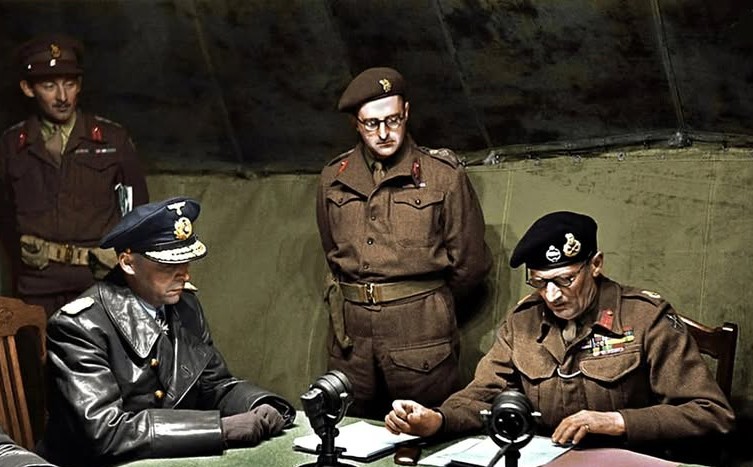 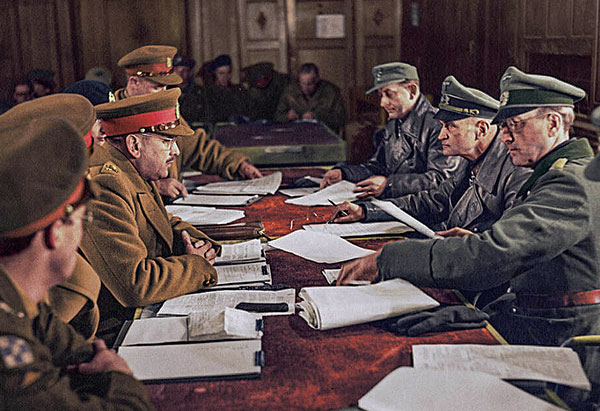 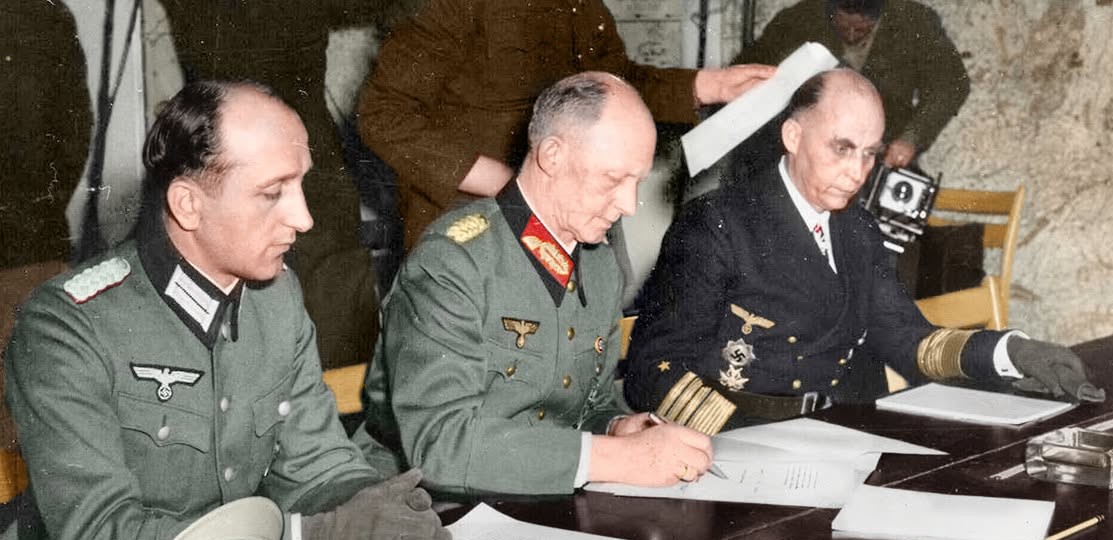 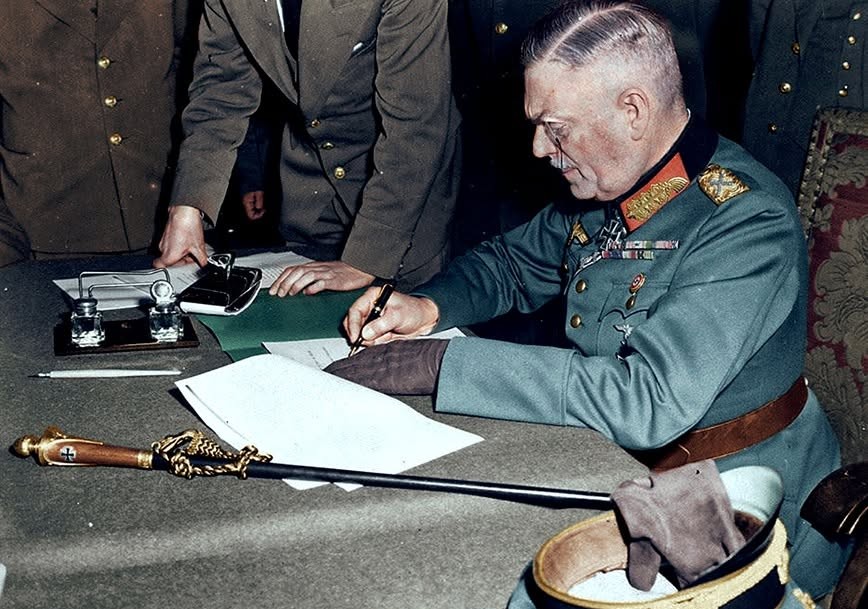
Fig.: Iconic photographs
(all colorized after World War
2) of the surrender locations.
From top to bottom: Timeloberg,
Wageningen, Reims & Berlin
|
REASON FOR INVESTIGATION
The final days of World War
Two in Northwestern Europe saw
several separate locations where
German military authorities
formally or informally
acknowledged defeat. These
sites, though historically
significant, are not widely
known to the general public, and
their roles in the surrender
process are often misunderstood
or blended. Because of this,
this agency undertook an
investigation to document the
exact locations, clarify their
individual functions, and
examine the circumstances
surrounding each event. To
accomplish this, we visited the
sites, reviewed archival
material, and investigated the
details surrounding the
surrender ceremonies. This case
file presents our findings.
|
SYNOPSIS:
The
surrender of German forces in
Northwestern Europe in early
MAY1945 was not a single,
unified event. Instead, it
unfolded across several
locations, each with its own
political, military, and
symbolic significance. The four
principal sites examined in this
Battle Study—Timeloberg,
Wageningen, Reims, and
Berlin‑Karlshorst—represent
distinct moments in the process
by which the Third Reich’s
military structure collapsed and
Allied forces imposed the terms
of unconditional surrender.
|
1. Timeloberg,
Germany – Montgomery’s Tactical
Headquarters
The
first of these locations is the
Timeloberg, a low hill near
Wendisch Evern in northern
Germany. On 4MAY1945, Field
Marshal Sir Bernard L.
Montgomery accepted the
surrender of German forces in
the Netherlands, northwest
Germany, and Denmark. The
original signing took place
inside Montgomery’s Tactical
Headquarters, which at the time
was located on a military
training area. Because the site
remained under military control
after the war, the original
monument commemorating the
surrender was eventually
relocated to the Royal Military
Academy Sandhurst in the United
Kingdom. Today, a modern
memorial—Gedenkort
Timeloberg—stands outside the
restricted zone, marking the
general location of the event.
At Timeloberg, Generaladmiral
Hans-Georg von Friedeburg,
representing the German High
Command, signed the instrument
of surrender for all German
forces facing Montgomery’s 21st
Army Group.
|
(click to enlarge)
.jpg)
Fig.: Acceptance of
surrender of German forces in
Northern Europe
by Field
Marshall Bernard L. Montgomery
on Timeloberg on 4MAY1945 |
This agency visited the memorial
site om 23AUG2026.
|
(click to enlarge)
_small.jpg)
_small.jpg)
_small.jpg)
_small.jpg)
_small.jpg)
_small.jpg)
_small.jpg)
Fig.: The monument on
Timeloberg just outside the
military facility. It is a sober
memorial.
The large stone
has been vandalized in the past
after which a new text has been
inscribed and the stone turned
around.
|
Denmark
This
document included the
capitulation of German troops in
Denmark, though no formal
surrender ceremony ever took
place there. Instead, the Danish
correspondent of the BBC
broadcast the news of the
surrender on the evening of
4MAY1945, prompting spontaneous
nationwide celebrations. The
Danish population learned of
liberation not through a signed
document, but through the radio.
The Timeloberg surrender was a
major step in the disintegration
of German military authority in
the northwest, but it was not
the final or most comprehensive
act of capitulation.
|
2. Hotel De Wereld,
Wageningen, The Netherlands – A
Meeting, Not a Signing
The second location investigated
is the Hotel De Wereld in
Wageningen, The Netherlands.
Contrary to popular belief, no
surrender was signed here. On
4MAY1945, a copy of the
instrument signed at Timeloberg
was handed to Generaloberst
Johannes Blaskowitz, commander
of German forces in the
Netherlands. The following day,
5MAY1945, Blaskowitz returned to
the hotel with an inventory of
all German troops under his
command, fulfilling Montgomery’s
requirement for a complete
accounting of enemy forces.
|
(click to enlarge)
.jpg)
Fig.: The German command
hands over an inventory of
German troops in the Netherlands
in hotel De Wereld in
Wageneningen on 5MAY1945.
|
The meetings in Wageningen were
therefore administrative in
nature: they served to inform
the German command structure in
the Netherlands of the surrender
already signed elsewhere and to
ensure compliance with Allied
instructions. The location
gained symbolic importance in
Dutch collective memory, but
historically it functioned as a
site of communication rather
than capitulation.
This
agency visited hotel De Wereld
in Wageningen and its
"Capitulation Hall" several
times; most recently on
9SEP2026.
|
(click to enlarge)
_small.jpg)
_small.jpg)
_small.jpg)
_small.jpg)
_small.jpg)
_small.jpg)
_small.jpg)
_small.jpg)
_small.jpg)
_small.jpg)
Fig.: Even to this day
the Hotel de Wereld capitalizes
on the myth that a capitulation
was signed in the building.
|
3. Reims, France – The
First Unconditional Surrender of
All German Forces
The third location is the former
"Collège Moderne et Technique"
in Reims, France. In the early
hours of 7MAY1945, Generaloberst
Alfred Jodl, Chief of the
Operations Staff of the German
Armed Forces High Command (OKW),
signed the unconditional
surrender of all German forces
to the Western Allies. The
ceremony took place inside the
war room of Supreme Headquarters
Allied Expeditionary Force
(SHAEF), under the authority of
General Dwight D. Eisenhower.
The Reims surrender was intended
to be the definitive act ending
hostilities in Europe. It
stipulated that all German
forces were to cease operations
at 23:01 hours Central European
Time on 8MAY1945.
|
(click to enlarge)
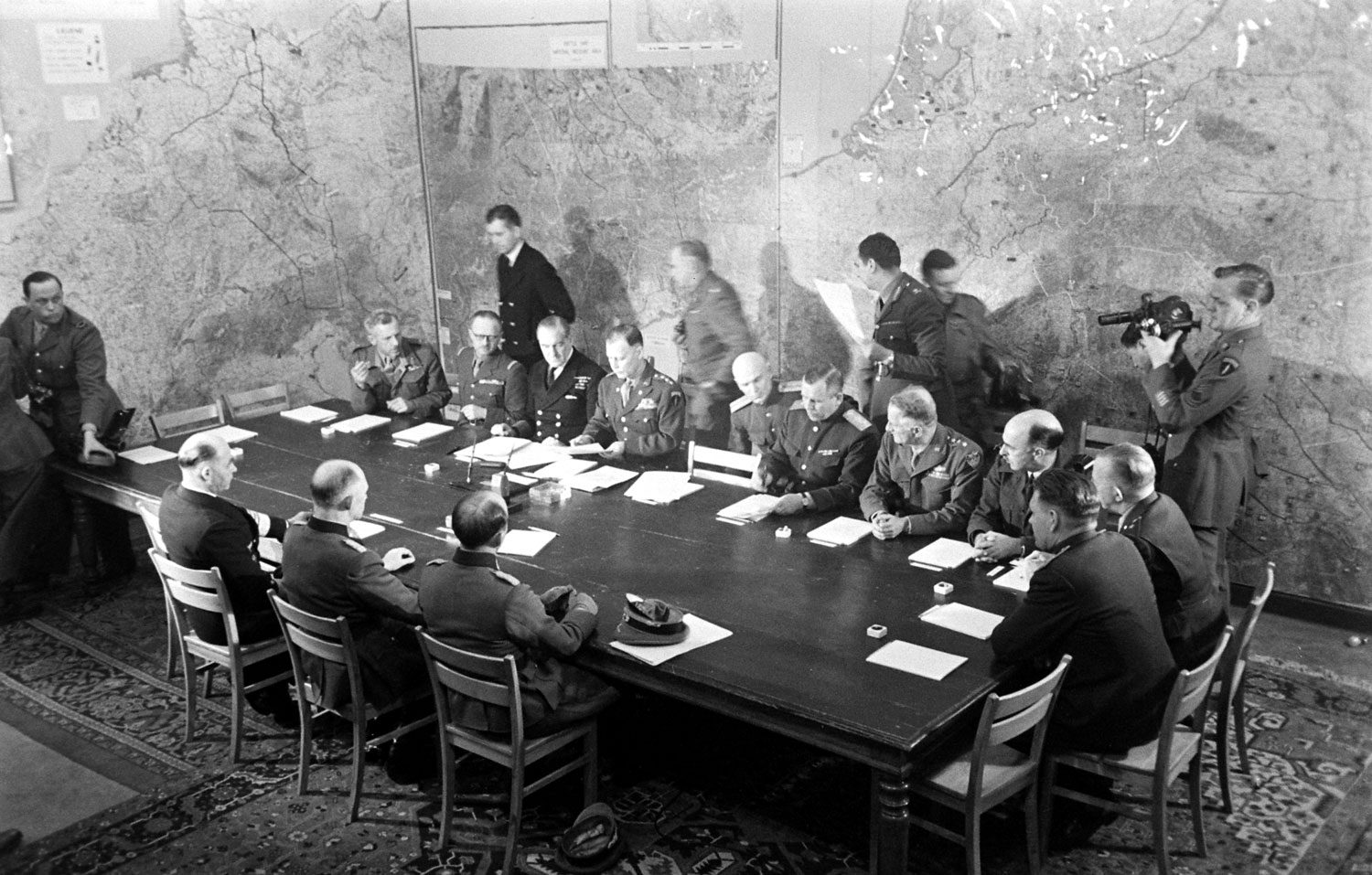
Fig.: Generaloberst Alfred
Jodl signed the unconditional
surrender of all German forces
to the Western Allies
in the Collège Moderne et Technique
in Reims on 7MAY1945.
|
(click to enlarge)
.jpg)
.jpg)
Fig.: The surrender
documents signed in Reims in the
English language. |
Representatives of the
Soviet Union were present, but
they objected to the ceremony.
Marshal Georgy Zhukov and other
Soviet leaders insisted that the
surrender be signed again, in
Berlin, the capital of the
defeated Reich, and under Soviet
authority. They argued that the
Reims ceremony was merely a
preliminary act.
As a result,
although the Reims surrender is
recognized by Western nations as
the official end of the war in
Europe, it was not accepted as
final by the Soviet Union.
This agency visited the
former Collège Moderne et Technique
on 3MAR2018.
At present the
buidling houses the
Museum of the Surrender of May
7, 1945.
|
(click to enlarge)
_small.jpg)
_small.jpg)
_small.jpg)
_small.jpg)
_small.jpg)
_small.jpg)
_small.jpg)
Fig.: Exterior and war room
in the former Collège Moderne et Technique
in Reims.
_small.jpg)
_small.jpg)
Fig.: Chairs of
Generalobert Alfred Jodl and
Admiral Hans-Georg Friedrich
Ludwig Robert von Friedeburg.
|
4. Berlin-Karlshorst,
Germany – The Soviet Ceremony
and the Final Act
The fourth location is the
officers mess of the former
Wehrmacht Pioneer School in
Berlin‑Karlshorst. On the night
of 8–9 MAY1945, a second
surrender ceremony took place
here, organized by the Soviet
High Command. The building later
became the German‑Russian Museum
during the Cold War and today
houses a museum dedicated to the
surrender and the end of the
war.
At Karlshorst,
representatives of the German
High Command—including Field
Marshal Wilhelm Keitel—signed
another instrument of
unconditional surrender.
|
(click to enlarge)
.jpg)
Fig.: Representatives of the
German High Command signed the
Soviet version of the instrument
of unconditional surrender.
|
(click to enlarge)
_small.jpg)
_small.jpg)
_small.jpg)
_small.jpg)
_small.jpg)
_small.jpg)
_small.jpg)
_small.jpg)
Fig.: From top to bottom:
The surrender documents signed
in Berlin in the English, German
and Russian languages.
|
This
time the Soviet authority was
acknowledged explicitely. Because of the
time difference between Central
European Time and Moscow Time,
the Soviet Union recorded the
date of the surrender as
9MAY1945. This is why Victory
Day is celebrated on 9MAY in
Russia and several other former
Soviet republics.
The
Karlshorst ceremony was not a
new surrender but a politically
motivated repetition of the
Reims signing. It provided the
Soviet Union with its own moment
of triumph and ensured that the
end of the war would be
commemorated in a manner
consistent with Soviet political
and military priorities.
This agency visited the former
officers mess in
Berlin-Karlshorst on 19APR2015.
|
(click to enlarge)
_small.jpg)
_small.jpg)
_small.jpg)
_small.jpg)
_small.jpg)
_small.jpg)
_small.jpg)
Fig.: Exterior and ceremony
hall room in the officers mess
of the former Wehrmacht Pioneer
School in Berlin‑Karlshorst.
|
|
CONCLUSION:
This investigation examined four
locations associated with the
German surrender in Northwestern
Europe in MAY1945. Each site
played a distinct role in the
complex process by which the
Third Reich’s military forces
capitulated to the Allies.
The Timeloberg was the site of
Montgomery’s acceptance of the
surrender of German forces in
the northwest, including
Denmark, though no formal
ceremony ever took place in
Denmark itself. The memorial now
stands outside the military
grounds where the original
Tactical Headquarters was
located. Wageningen’s Hotel De
Wereld served only as a meeting
place where German commanders
were informed of the surrender
already signed at Timeloberg and
where they provided troop
inventories; no surrender
document was signed there. Reims
was the location of the first
unconditional surrender of all
German forces, signed under
SHAEF authority, but rejected by
the Soviets as insufficient.
Berlin‑Karlshorst was chosen by
the Soviet High Command to stage
their own ceremony, allowing
them to claim a separate and
symbolically powerful moment of
victory over Nazi Germany.
Together, these locations
illustrate that the German
surrender was not a single event
but a sequence of coordinated
acts shaped by military
necessity, political rivalry,
and the desire of each Allied
power to define the end of the
war on its own terms. |
|
EXHIBITS:
Both the buildings in Reims and
Berlin have a modest display of
artefacts from World War Two
which we found very interesting. |
|
(click to enlarge)
_small.jpg)
_small.jpg)
Fig.: Reims.
One of the
artefacts, an invitation to a
football game, is featured in
our
Battle Relic # 4.
_small.jpg)
_small.jpg)
_small.jpg)
_small.jpg)
_small.jpg)
Fig.: Berlin-Karslhorst.
Still stemming from the Cold War
era, much emphasis in the
displays is put on the role of
the Nazi's and their war crimes
in World War Two.
|
|
Back to Battle Studies
 |
| |









.jpg)
.jpg)
.jpg)
.jpg)
.jpg)
.jpg)
.jpg)
.jpg)
.jpg)
.jpg)
.jpg)
.jpg)
.jpg)
.jpg)
.jpg)
.jpg)
.jpg)
.jpg)
.jpg)
.jpg)
.jpg)
.jpg)
.jpg)
.jpg)
.jpg)
.jpg)
.jpg)
.jpg)
.jpg)
.jpg)
.jpg)
.jpg)
.jpg)
.jpg)
.jpg)
.jpg)
.jpg)
.jpg)
.jpg)
.jpg)
.jpg)
.jpg)
.jpg)
.jpg)
.jpg)
.jpg)
.jpg)
.jpg)
