Historical images compared with
the current situations in the exact
locations.
Click on the pictures to
enlarge. |
Normandy
Holland(1)
Holland(2)
Ardennes
Miscellaneous
|
|
(click on the images
for the full-size Now&Then
comparisons) |
.jpg) |
Frankfurt am Main, Germany, March
10, 1933
Mother Edith Frank poses with her
daughters Margot (left) and Anne in
their hometown. Anne was just four
years old when this picture was
taken. A few weeks later they fled
Nazi Germany to Holland. Anne's
wartime diary became an icon for the
senselessness of the Nazi regime
|
.jpg) |
Frankfurt am Main, Germany, May
1945
The ancient Hauptwache building in
downtown Frankfurt is in ruins after
numerous Allied bombing raids. |
.jpg) |
Frankfurt am Main, Germany, May
1945
For centuries the An der Hauptwache
Square remained unchanged. Hitler's
ideals of world domination also
resulted in the destruction of large
parts of this city in the Hessen
land.
|
.jpg) |
Elten, Germany, September 28th
1944
Panther tanks and support
vehicles of I./Panzer Regiment 24
move towards the Dutch border on
Klosterstraße to attack the Allied
bridgehead at Nijmegen. Note the
soldier on the right rendering the
Nazi salute to the men on the
motorcycle. |
.jpg) |
Elten, Germany, September 28th
1944
Like the previous photo this one
is also taken by Kriesberichter
Stachelscheid and only a few steps
away from Klosterstraße. A Panther
tank of I./Panzer Regiment 24 rolls
past on Markt square. |
_small.jpg) |
Cologne, Germany, March 6th, 1945
A German Mark V Panther tank sits
smoldering in front of the ancient
Dom Cathedral in Cologne, Germany. |
_small.jpg) |
Cologne, March 1945
American soldiers of the 3rd Armored
Division inspect the destroyed
Panther tank. A brand new M-26
Pershing tank, commanded by Sgt.
Robert Early of "E" Co./ 32nd
Armored Regiment, had knocked it out
on the 6th of March 1945. |
_small.jpg) |
Cologne, March 1945
Shortly
after the Panther was knocked out, a
sign was posted near it reading:
"SIGHT SEERS KEEP OUT! Beyond this
point you draw fire on our FIGHTING
MEN. He risks his life 24 hours a
day. DO YOU?" We played "sight
seers" for this comparison.
|
_small.jpg) |
Cologne, March
1945
After Sgt
Early's tank knocked out
the Panther, it burned
for three days. Shortly
after the capture of
Cologne, the Panther was
towed in front of the
cathedral to make way to
through-traffic. |
.jpg) |
Cologne, Germany, March 6th 1945
The following 5 comparisons are
to illustrate the events leading to
the destruction of the Panther in
the previous 4 photos. Two Sherman
tanks from "F" Co./32nd Armored
Regiment are standing on
Komödienstrasse when suddenly a
shell from the Panther tank hits the
leading US tank; killing most of its
crew.
|
.jpg) |
Cologne, Germany, March 6th 1945
Sgt. Robert Early of "E" Co./
32nd Armored Regiment is ordered to
take out the Panther with his
Pershing tank and moves forward on
An Den Dominikanern, seen here
passing the building of the
Reichsbank. |
.jpg) |
Cologne, Germany, March 6th 1945
The Pershing tank turns right on
Marzellenstrasse where the Panther
tank is spotted at the far end of
the street; and destroyed with canon
and .50 caliber machinegun fire. |
.jpg) |
Cologne, Germany, March 6th 1945
Since taking the first 4 photos
of the destroyed Panther tank in
Cologne, we learned that the wreck
was positioned a bit further down
Komödienstrasse and that the square
in front of the Dom cathedral was
raised post-war. |
.jpg) |
Cologne, Germany, March 6th 1945
American infantrymen inspect the
destroyed Panther tank on the
junction of Komödienstrasse and
Marzellenstrasse. |
.jpg) |
Münster Germany, April 2nd 1945
American paratroopers of the
17th Airborne Division and British
soldiers of the 6th Guards Tank
Brigade meet in front of the bomb
damaged town hall of Münster on
Prinzipalmarkt were in 1648 the
Peace Treaty of Westfalia was
signed. In the background is the
Saint Lambert Church. |
.jpg) |
Münster Germany, April 2nd 1945
American paratroopers, some of
them hitching a ride on the British
tank in the center of Prinzipalmarkt,
advance past the historic town hall
of Münster. |
.jpg) |
Münster Germany, Spring 1945
Two American M4 Sherman tanks
with extra sandbags on their fronts
for protection, move down Alter
Steinweg with the Saint Lambert
Church and some German civilians in
the background. Today the new
Primark building on the left blocks
the one in the "Then" photo. |
 |
Münster Germany, Spring 1945
Schloss Münster was bombed
several times and suffered serious
damage.
After the war, the British occupying
forces first planned the complete
demolition, but after protests by
German officials, the castle was
rebuilt to use it as an
administrative and lecture building
of State University. |
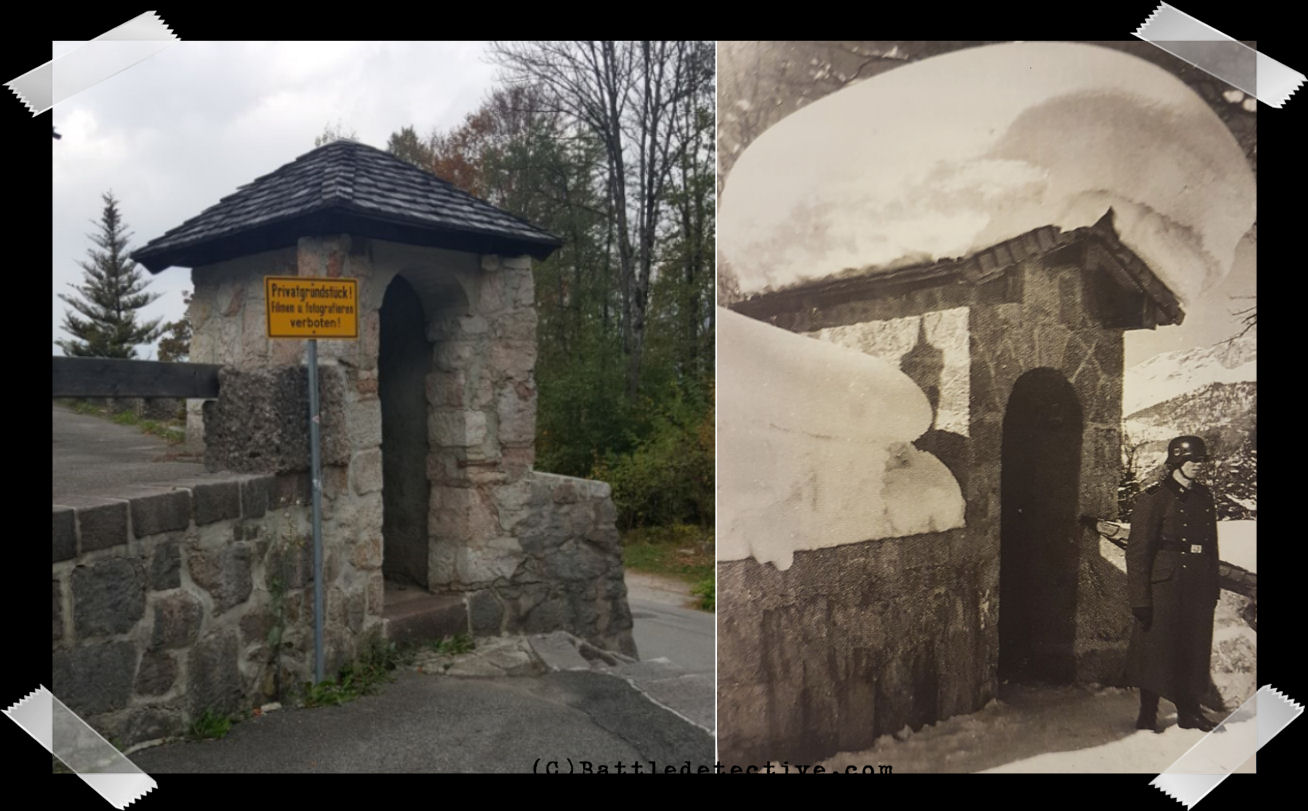 |
Berchtesgaden, Germany, late
1930's
Sentry box at the Zum Türken
hotel on the Obersalzberg outside of
Berchtesgaden. The hotel was the
Headquarters of the
Reichssicherheitsdienst which had
the task to protect the Führer who
lived in the Berghof right around
the corner. Then photo in arctic
conditions presumably taken in the
late 1930's. |
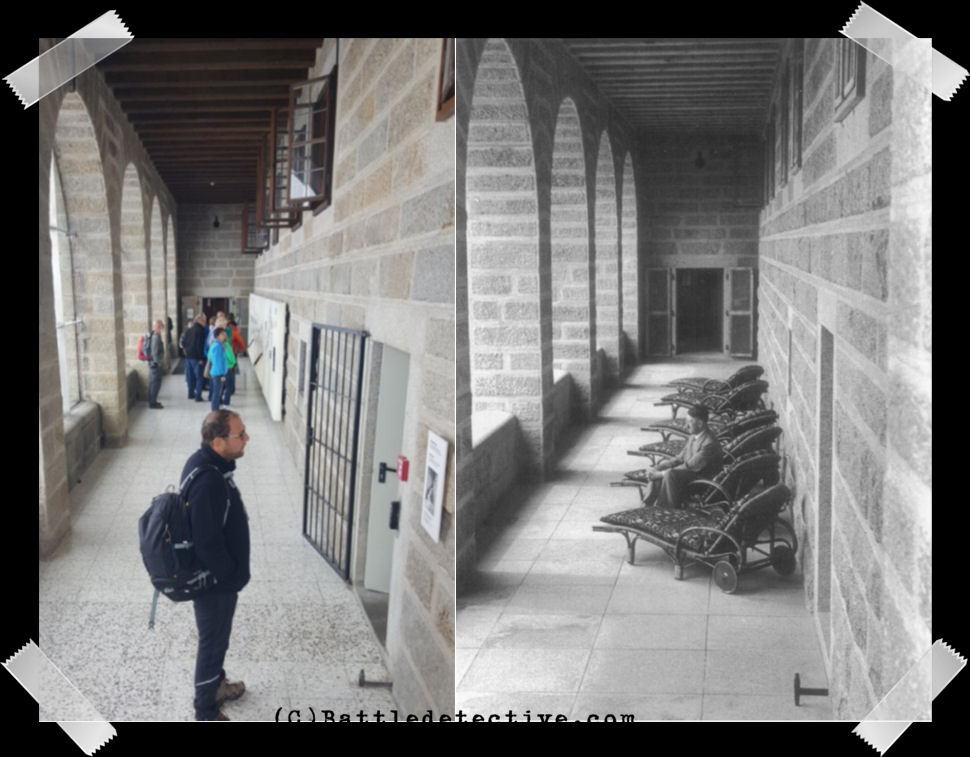 |
Berchtesgaden, Germany, late
1930's
A rare photograph of Adolf
Hitler in the Kehlsteinhaus.
Although it cost a fortune in
taxpayers' Reichmarks and was a gift
from the Third Reich people to their
Führer for his 50th birthday, Hitler
seldom visited the Kehlsteinhaus
because of his aversion to the thin
mountain air and its high altitude.
In the comparison we see the roofed
sun terrace which today shows the
history of the building on
information panels. |
.jpg) |
Berchtesgaden, Germany, May 1945
The entrance of the tunnel to
the elevator to the Eagle's Nest,
built in 1938. Then photo of
American soldiers at the end of
World War Two in 1945. |
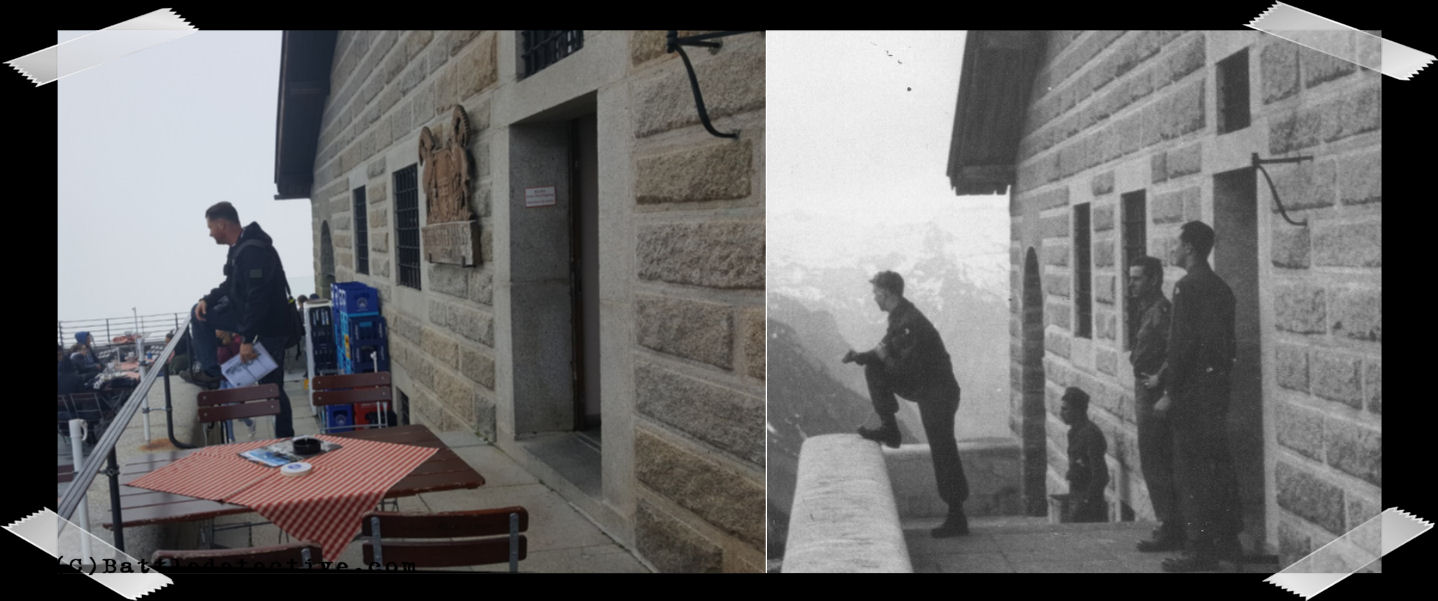 |
Berchtesgaden, Germany, May 1945
American paratroopers of the
101st Airborne Division enjoy the
view from the terrace of the
Kehlsteinhaus. |
.jpg) |
Berchtesgaden, Germany, May 1945
American paratroopers of the
101st Airborne Division relax in the
comfortable chairs of the main room
of the Kehlsteinhaus and drink to
celebrate the end of World War Two. |
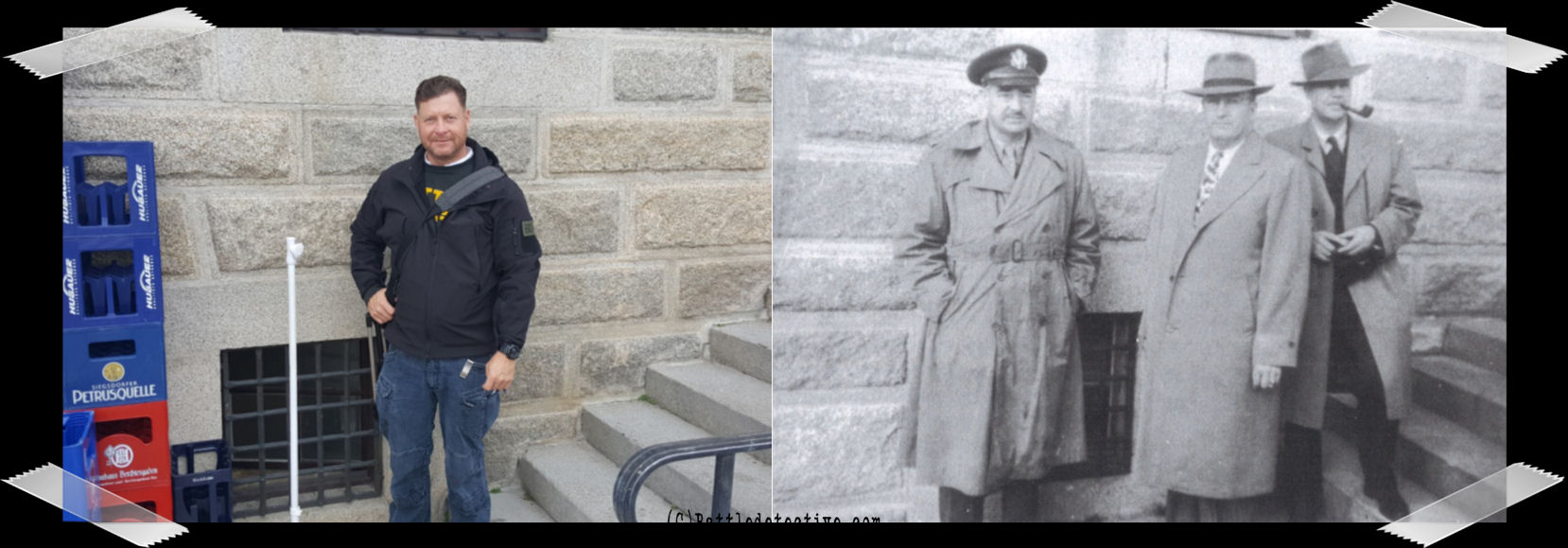 |
Berchtesgaden, Germany, 1945
Detectives at the Kehlsteinhaus
inspecting Adolf Hitler's alpine
retreat. |
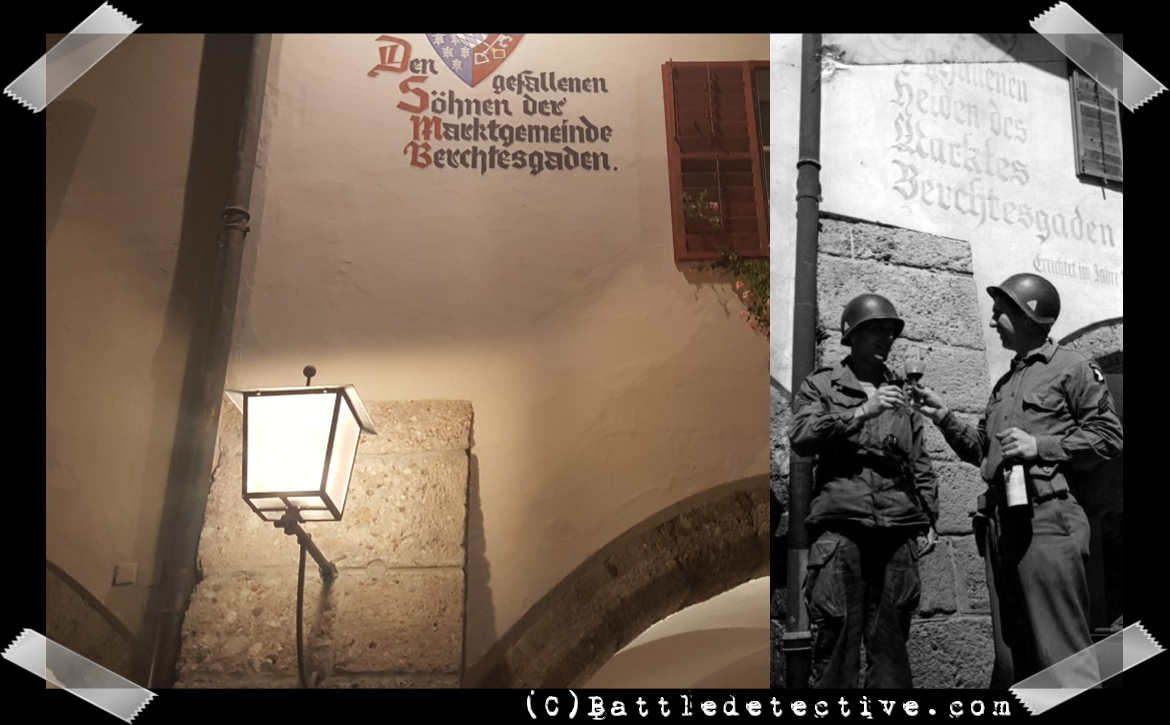 |
Berchtesgaden, Germany, 1945
Soldiers of the 81st Airborne
Anti-Aircraft Battalion of the 101st
Airborne Division take time for a
toast under a mural on the
SchlossPlatz square. The text says:
"To the fallen heroes of the
Berchtesgaden market", but is
changed to "the fallen sons of the
Berchtesgaden market community"
today. |
 |
Berlin, Germany 1938
The
Reichstag-(German Nazi-Parliament)
building today and in its glory days
of the Third Reich in 1938.
'Now'-photograph courtesy of Battle
Detective Wilbert.
|
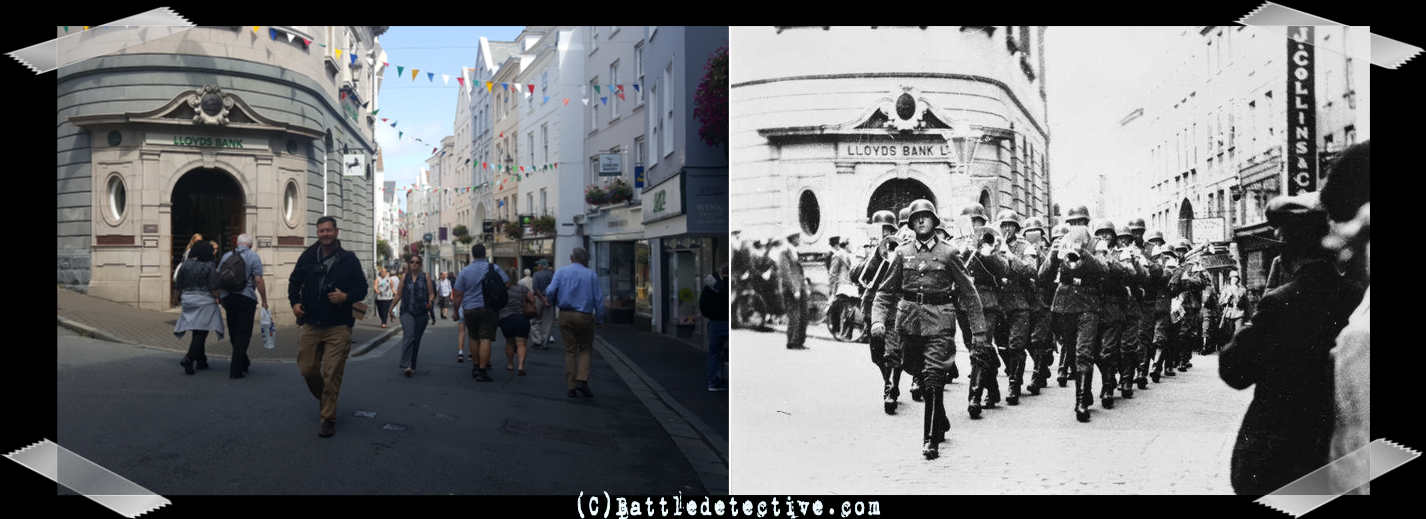 |
Saint Peter Port, Guernsey,
Channel Islands, June 1940
The Channel Islands were the only
part of Great Britain under Nazi
control during World War 2. On
30JUN1940 German troops began to
arrive at Guernsey. Here, a
Wehrmacht band is seen parading
through High Street in St. Peter
Port.
|
 |
Hungerford
Berkshire, England, 1943-1944
Officers in both Class A
uniforms and in battle gear, talk to
Colonel Robert F. Sink who is seated
on a waiting bench. He is the
commanding officer of the 506th
Parachute Infantry Regiment which is
stationed in the local area. The
officer talking to he Colonel is
identified as S-3 officer of 3rd
Battalion, Captain Charles G.
Shettle."Then-" photo by 1st
Lieutenant John Reeder. |
 |
Hungerford
Berkshire, England, 1943-1944
Unidentified officer of the
506th Parachute Infantry Regiment at
the Hungerford railway station.
The station stopped
processing cargo traffic in 1970,
and became an unstaffed halt leading
to the demolition of the station
buildings (except the 1902
footbridge over the tracks) in 1971.
The footbridge was replaced by the
current modern structure in 1999.
|
 |
On B4192
near Aldbourne, Wiltshire, England
1943
Paratroopers of the
506th Parachute Infantry Regiment
during a Field Training Exercise
(called "problem" at the time) are
seen marching on the road from
Aldbourne to Hungerford approaching
the crossroads to Eastridge and
Ramsbury. The road has been
renumbered from A419 to B4192 after
the war. |
 |
Littlecote
House near Hungerford in Berkshire,
England 1943
A sentry
stands guard at the entrance
building of the Littlecote estate
where the 506th Parachute Infantry
Regiment of the United States Army
had its headquarters before D-Day
and before Operation "Market
Garden". |
 |
Littlecote
House near Hungerford in Berkshire,
England 1943
From the
photo collection of 1LT John Reeder
of the 506th Parachute Infantry
Regiment comes this postcard-like
picture of Littlecote House;
Regimental HQ. We took the
comparisson on 03SEP2025 |
 |
Littlecote
House near Hungerford in Berkshire,
England 1943
Paratroopers
of the 506th Parachute Infantry
Regiment march past a stand with
Regimental commander Colonel Sink
and Divisional Commander
Major-General Taylor. |
 |
Littlecote
House near Hungerford in Berkshire,
England 1943-1944
Officers
of the 506th Parachute Infantry
Regiment pose in the snow in front
of their Regimental Headquarters.
|
 |
Littlecote
House near Hungerford in Berkshire,
England 1943
The large
hall of Littlecote House served as
an officers mess. It remains largely
unchanged today. |
 |
Littlecote
House near Hungerford in Berkshire,
England 1943
A lady
visitor poses with the Stars and
Stripes, the Regimental flag of the
506th and two benches adorned with
the regimentals crests. |
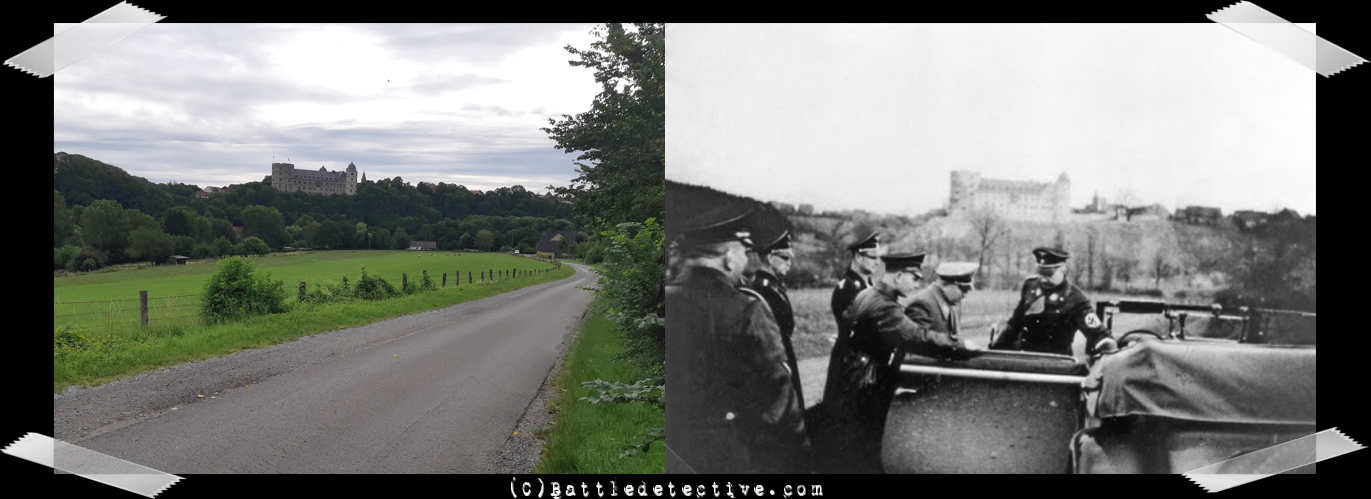 |
Wewelsburg Castle, Germany 1937
Reichsführer SS Heinrich Himmler
and NSDAP-Reichsorganisationsleiter
Ley board a car in 1937 near
Wewelsburg Castle; refurbished
Himmler in the 1930's to become the
Nazi equivalent of Camelot complete
with a hall for the twelve knights,
or "Obergruppenführersaal". |
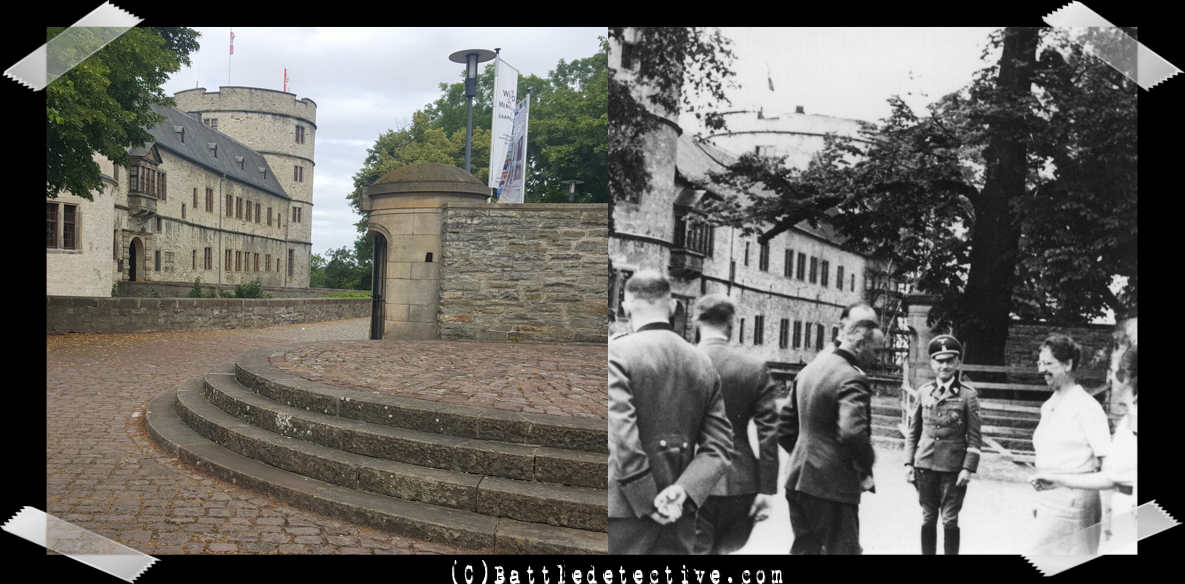 |
Wewelsburg Castle, Germany 1941
"Pow-wow of evil".
Gruppenführer assembly mid-June
1941.
In the background the eastern façade
of the castle. Burghauptmann
Siegfried Taubert looks towards the
camera. Reinhard Heydrich can be
seen on the left-hand side, and
Elfriede Wippermann, head of
housekeeping at Wewelsburg Castle,
on the right. |
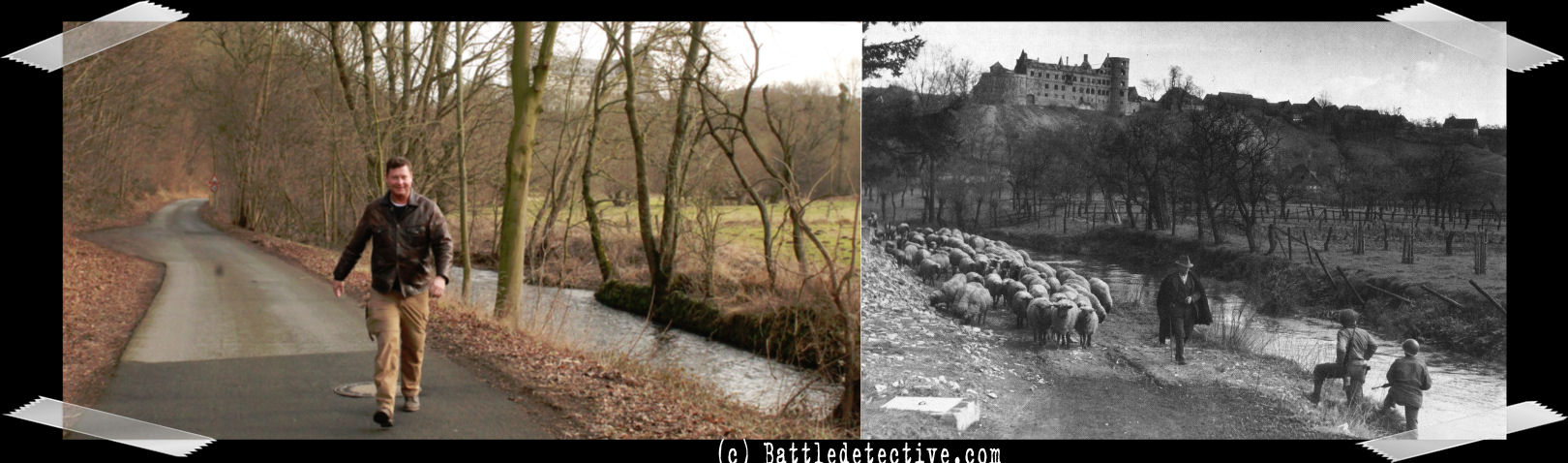 |
Wewelsburg Castle, Germany 1945
The"Then-"picture looks like a
peaceful image, but just a few days
hours earlier SS leader Heinrich
Himmler ordered this castle to be
destroyed. The castle was used as a
Nazi occult headquarters. |
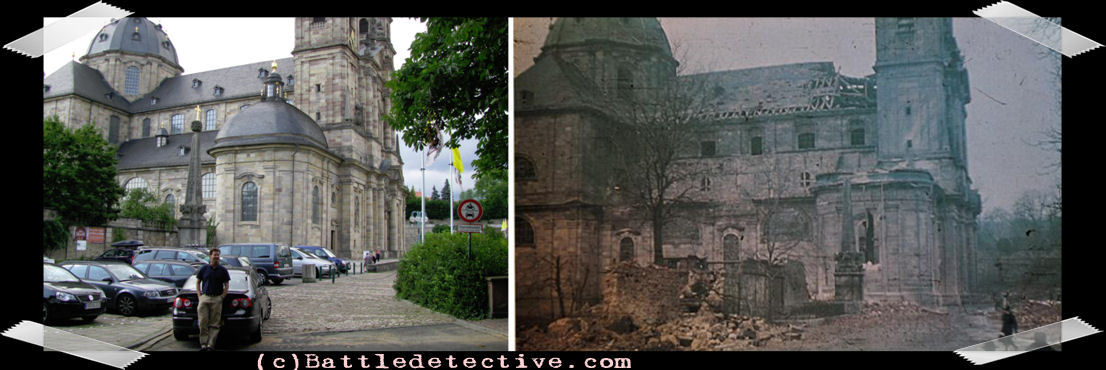 |
Fulda, Germany, 1944
The German city of Fulda was
bombed extensively in World War Two.
Almost 1500 people were killed in
Allied bombing raids of which the
one in the night of September 11 and
12, 1944 was the heaviest. This is
the Dom cathedral.
|
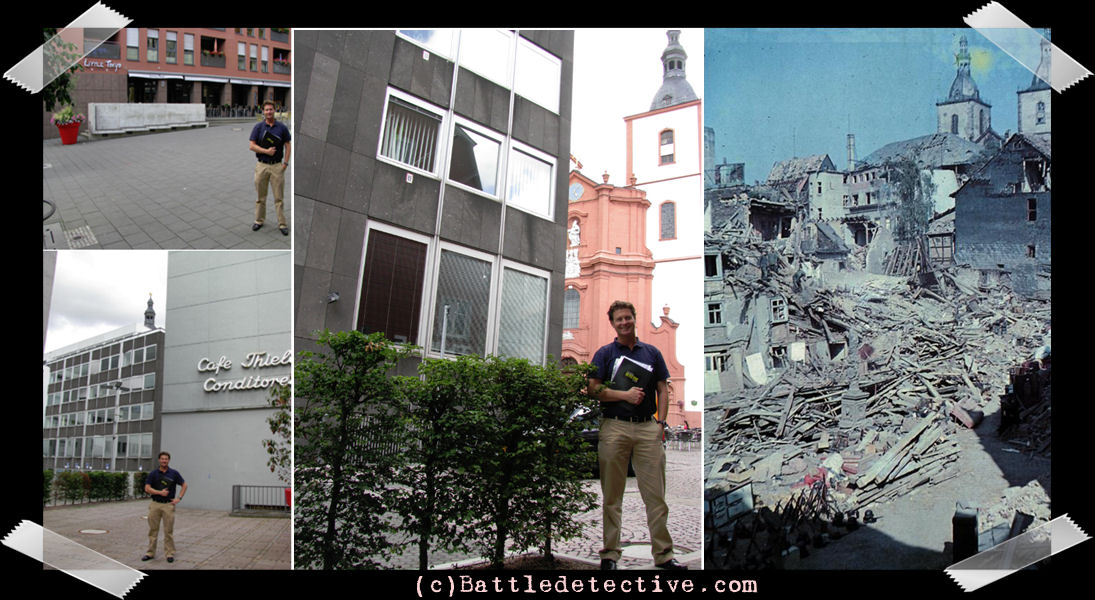 |
Fulda, Germany, 1944
Gemuesemarkt (Vegetable Market) after
the bombing of September 11th 1944.
Note stacked rifles and German
helmets in the period photograph,
left lower corner. We assume a unit
of soldiers was marched in to find
survivors. Today, Gemuesemarkt is a
street, not a square making an exact
comparison impossible. The upper
left picture is taken in the same
spot. We then moved closer to the
twin-tower church.
|
 |
Nürnberg, Germany, 1945
View on the bombed-out buildings
on Am Ölberg seen from the
Sinwellturm tower inside the
Imperial Castle. |
 |
Bamberg, Germany, 1945
An American M4 Sherman tank
drives on Königstraße and turns left
on Kettenbrückestraße and then
straight into the center of town. |
 |
Bamberg, Germany, 1945
An American jeep on the Untere
Brücke bridge in Bamberg inducates
the town is in Allied hands as
displaced persons walk by. |
 |
Bamberg, Germany, 1945
A bomb damaged building that
stood at No. 1 Grüner Markt
The Luftwaffe bombed the US Army
positions in Bamberg during the
night of 13APR1945. The attack
inflicted many casualties and
destroyed several vehicles and
buildings. The building in the
"Now-" photo has been rebuilt
postwar. |
 |
Bamberg, Germany, 1945
Civilians move about on Grüner
Markt in the shell-torn town after
occupation of the city by troops of
the Seventh U.S. Army. The Now-"
photo was a bit difficult to take
because of the Christmas market held
there when we visited Bamberg. |
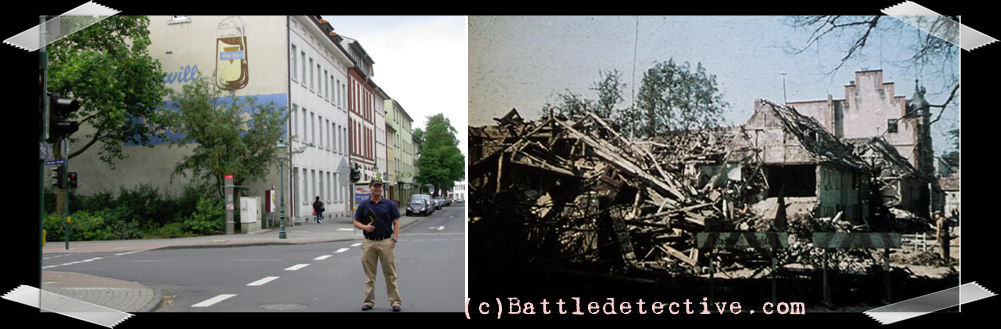 |
Fulda, Germany, 1944
Koenig Strasse. We could only find
this location because of the
photograph's caption stating that
this is near the Amtsgericht (Court
House). War damage and post-war
reconstruction changed this street
drastically.
|
.jpg) |
Vittoria, Sicily, 1943
Operation "Husky", with its D-Day on
July 10 1943, was the first Allied
invasion on European soil. As in the
landings in Normandy 11 months
later, the invasion of Sicily
was spearheaded by American and
British paratroopers. Here, American
soldiers of the 82nd Airborne
Division are marching down
Via Cavour in Vittoria. |
.jpg) |
Gela, Sicily, 1943
The US Army Signal Corps caption of
this photograph reads: "US Troops in
Gela on D+1". This is a few miles
inland from the American landing
beaches. The wreckage on the street
is of a knocked-out Italian tank. |
.jpg) |
Cassibile, Sicily, 1943
In the British sector, armored
troops move North from the landing
beaches in the direction of
Syracuse. In this photograph, a
Sherman tank leaves the old Market
Square on the outskirts of Cassibile.
The road in the foreground is the
SS115; the main highway along
the Eastern Sicilian coast. |
.jpg) |
Cassibile, Sicily, 1943
The same stretch of SS115 with the
majestic market square gate in the
background. This is the route to the
next objective: Syracuse. We think
the previous photograph with the
Sherman tank is a staged one for
propaganda purposes. |
.jpg) |
Catania, Sicily, 1943
Marines of the 7th Battalion Royal
Marines inch forward on the Piazza
del Duomo in Catania toward the Via
Etnea. |
.jpg) |
Catania, Sicily, 1943
The same location but just a few
yards further down the street. The
open gate in the gable behind
Battledetective Tom in the
"Now-photo" is the entrance of the
hotel where we stayed in, in Catania. |
.jpg) |
Catania, Sicily, 1943
Just around the corner of the
location in our first photograph of
Catania, these Marines dash forward
in the opposite direction. Due to
the finding in our
Battle Study # 15 that photo's
with action in the direction of the
camera are usually staged, we think
this one may be set up for
propaganda purposes.
|
.jpg) |
Acireale, Sicily, 1943
Ten miles North of Catania two
British Bren gunners and their
assistants cover a street corner on
the Via Vittorio Emmanuelle II in
Acireale. The house on the left is
No. 191 in that street today. |
.jpg) |
Acireale, Sicily, 1943
A
lone British "Tommy" peeks around
the corner of the Via degli Studi.
The street on the left hand side is
renamed Vico (Alley) degli Studi
after the war. |
.jpg) |
Auschwitz I, 1940-1945
This is the "Stammlager" or original
concentration camp, housing in
already existing housing barracks in
Oświęcim, Poland. The watchtowers,
fences and gate with the
infamous "Arbeit Macht Frei-" sign
were added by the Germans. |
.jpg) |
Auschwitz I, January 27th 1945
Surviving prisoners of the Nazi
concentration camp cheer and hug Red
Army soldier on the day the camp is
liberated. |
.jpg) |
Auschwitz I, January 27th 1945
The end of Nazi tyranny when a
Russian soldier approaches the main
gate of Auschwitz.
|
.jpg) |
Auschwitz I, January 27th 1945
Russian soldiers with prisoners
of Block 19, the quarantine
blockhouse in the medical section of
the camp.
|
.jpg) |
Auschwitz I, January 27th 1945
Russian Army nurse with
liberated children in Auschwitz.
Many of them were twins as the
Nazi's performed criminal medical
experiments on twins to test
effects. |
.jpg) |
Auschwitz-Birkenau, 1945
The train platform inside
Auschwitz-Birkenau were so many Jews
met their death in the Nazi gas
chambers. Photo taken after the
liberation of the camp by the
Russian Army. Note prisoner food
bowls in foreground. |
.jpg) |
Auschwitz-Birkenau, January 27th
1945
Not the exact location down to
the very yard but this is in the "Kanada-"
section of Auschwitz-Birkenau were
all the belongings of the prisoners
and gas chamber victims were stored.
The Nazi's torched the barracks in
an attempt to destroy evidence of
their crimes. "Then"-photo by Red
Army shows barracks still burning on
the day the camp was liberated. |
.jpg) |
Fort Eben Emaël, Belgium, May
1940
German soldiers discuss tactics used
during the attack on the artillery
cupolas of the Belgian Fort Eben
Emaël on May 10 1940. The fort was
considered impenetrable by the
Belgian defenders, but was put of
action by German glider troops
within an hour. |
.jpg) |
Fort Eben Emaël, Belgium, May
1940
The fort's main artillery
cupola, "Cp 120", on the middle of
the plateau on top of the fort. It
featured two 120 millimeter guns.
Note the circular impact marks of
the dome shaped German hollow
charges used to silence armored gun
and observation positions. |
.jpg) |
Fort Eben Emaël, Belgium, May
1940
German soldiers pose in front of
"Bloc I", the main entrance block of
the fort, during what is likely an
after action analysis visit to the
battlefield by members of taskforce
"Granit" under Oberleutnant Witzig. |
.jpg) |
Fort Eben Emaël, Belgium, May
1940
Armored observation turret on the
south east corner of the fort
overlooking the Albert Canal. The
terrain in the distance is on Dutch
territory. |
.jpg) |
Fort Eben Emaël, Belgium,
September 1944
GI's of the US Army's 30th Infantry
Division at the main entrance of the
fort. On the 10th of September 1944
the fort fell into Allied hands
without a single shot fired. |
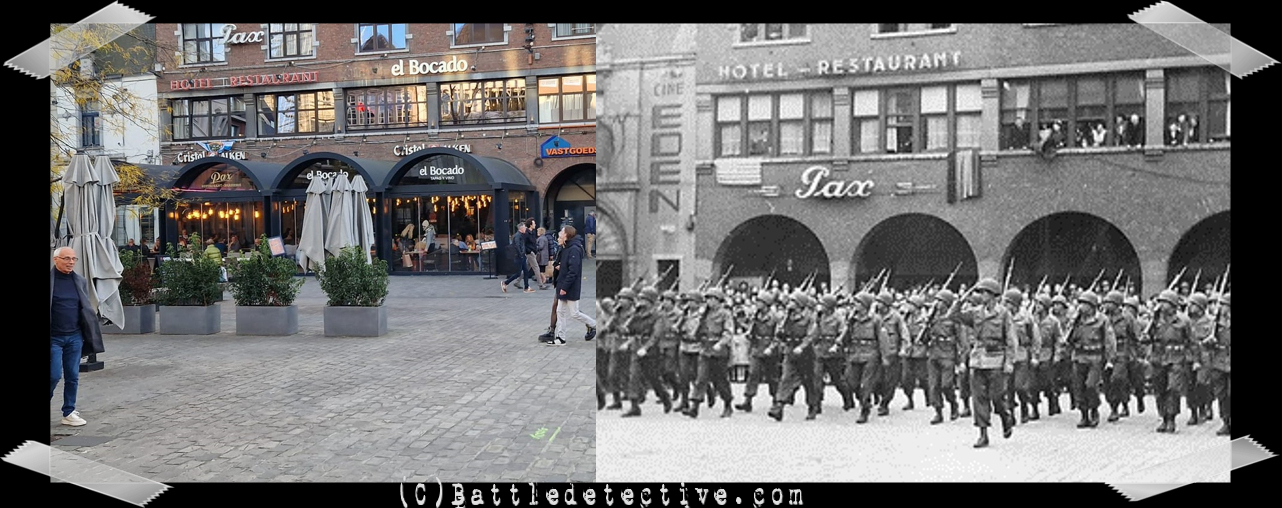 |
Hasselt, Belgium March 25th 1945
On Grote Markt square, U.S. 82nd
Armored Reconnaissance Battalion of
the 2nd Armored Division parades in
East Belgian town of Hasselt, led by
66th Armored Regiment military band. |
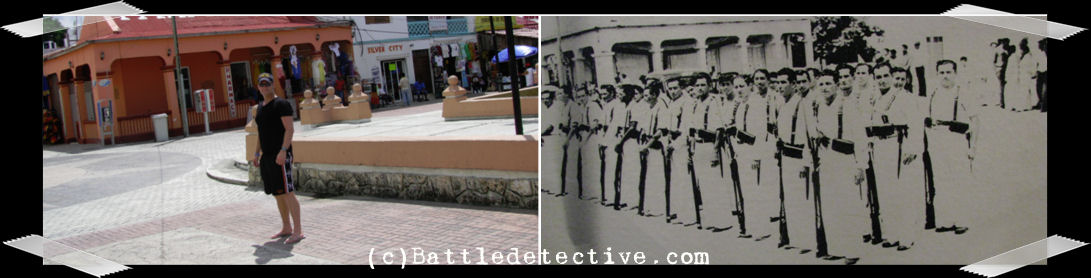 |
Cozumel, Mexico, 1944
"Reservistas" of the
defense force of the Mexican Island
of Cozumel stand at attention during
a parade on the island's main
square. Mexico declared war on the
Axis Powers in 1943.
|
.jpg) |
Paris, France, June 1940
German soldiers march down the
the Champs Élysées after their
capture of the French capital. |
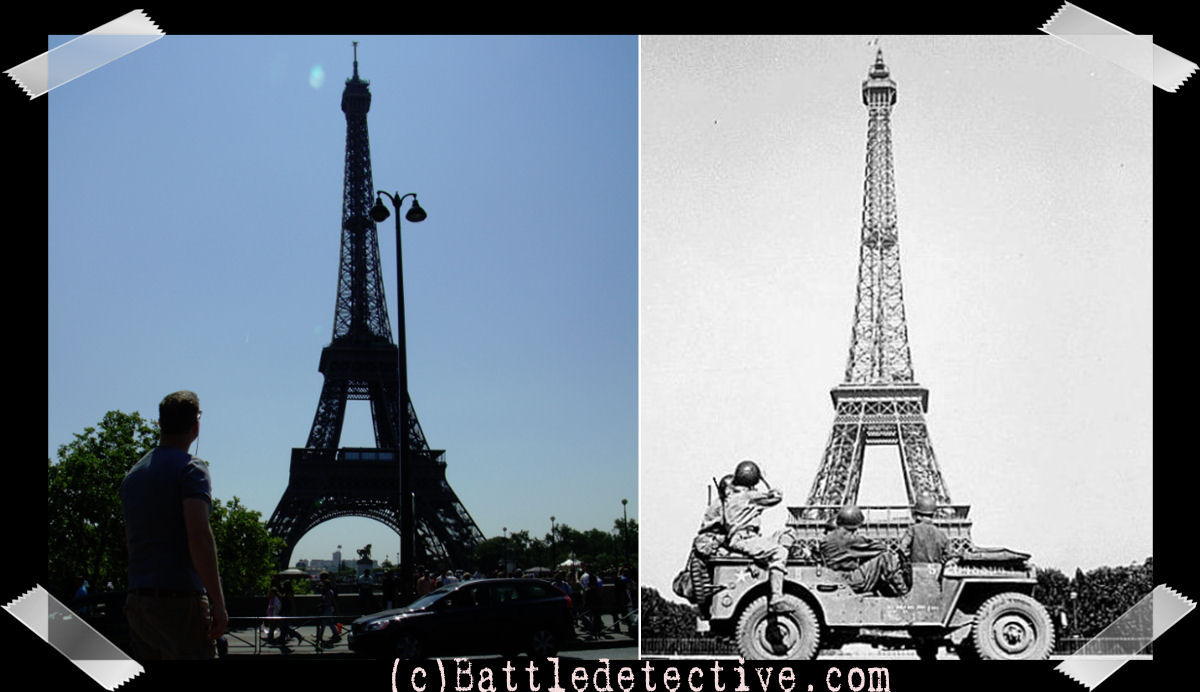 |
Paris, France, August 1944
Battle Detective Tom looks up at the
Eiffel Tower just as American G.I.'s
did 67 years earlier. The German
garrison of Paris surrendered on the
25th of August 1944. |
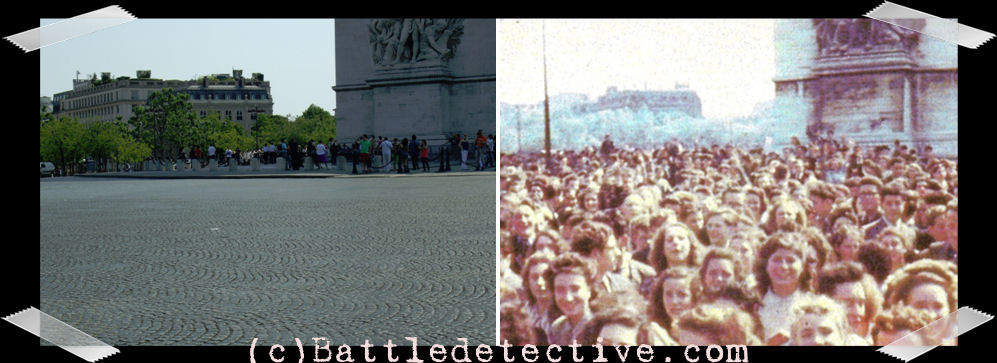 |
Paris, France, August 26th 1944
Parisians gather en masse in the Place de l'Étoile
to see the liberators of their city.
In 1970 this square was renamed
Place General de Gaulle in honor of
the commanding general of the Free
French Forces.
|
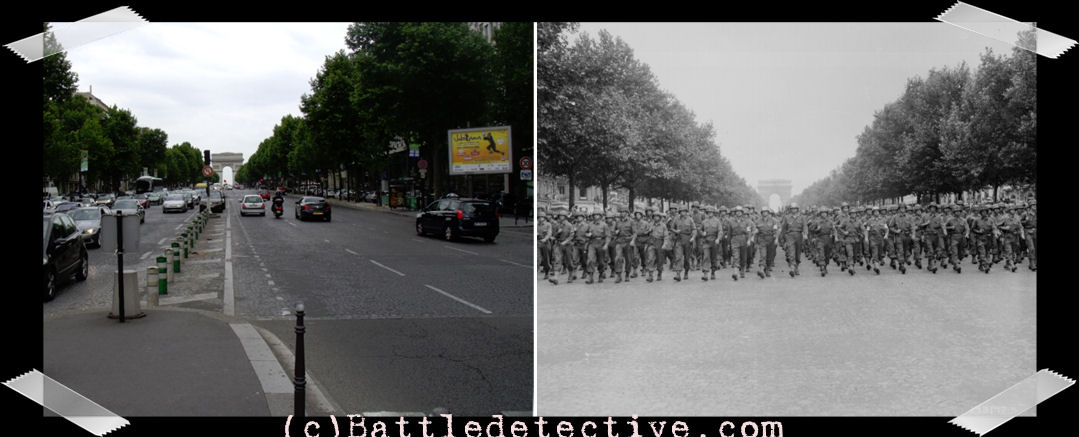 |
Paris, France, August 26th 1944
American soldiers of the 28th
Infantry Division march down the
Champs-Élysées, on a victory parade
on the 26th of august 1944. This was
a combined parade of the 28th US
Infantry and the 2nd French Armored
Divisions. |
.jpg) |
Paris, France, August 26th 1944
The
color guard of the 28th Infantry
Division march in front of the Arc de Triomphe. |
.jpg) |
Paris, France, August 26th 1944
An
American M8 Light Armored Scout Car
parades in front of the Arc de
Triomphe. The M8 usually was fitted
with a 37 mm M6 gun and a coaxially
mounted .30 caliber Browning machine
gun in an open-topped, welded
turret. A .50 caliber Browning
machine gun, as seen here, was
sometimes carried on a ring mount
for anti-aircraft use. |
.jpg) |
Paris, France, August 26th 1944
The
French 2nd Armored Division of
General LeClerc is seen here on the
Liberation Parade on the 26th of
August. |
.jpg) |
Paris, France, August 26th 1944
Parisians line the Champs Élysées as
the French 2nd Armored Division
tanks and half tracks pass before
the Arc de Triomphe. |
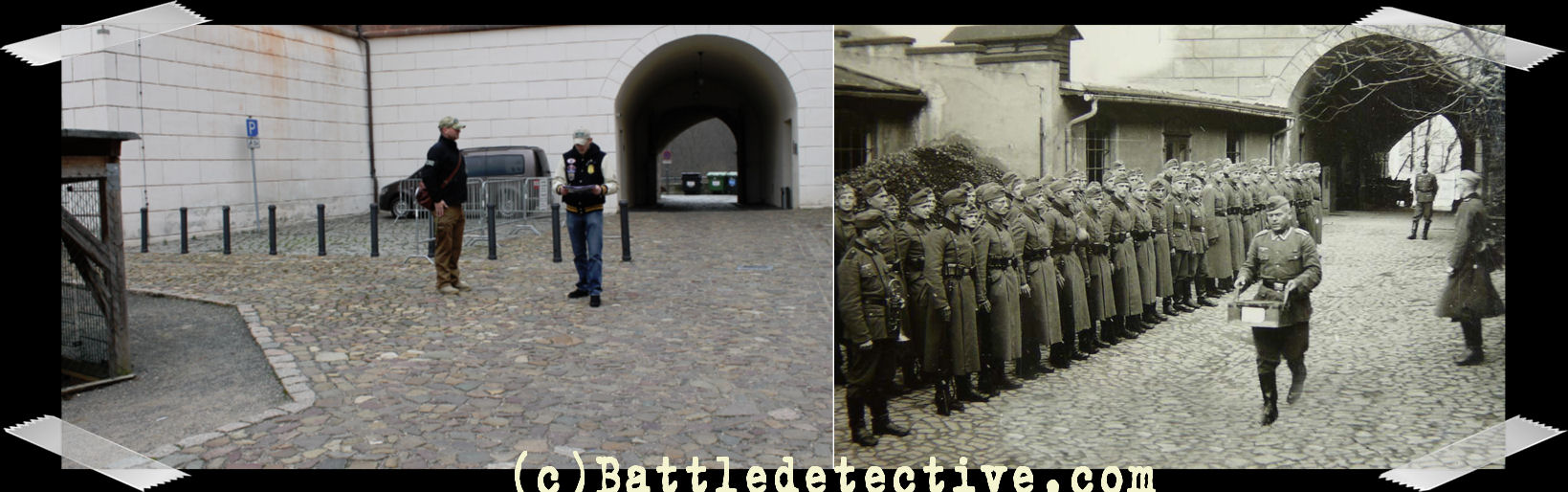 |
Colditz, Germany, 1939-1945
The guard garrison of Oflag IV-C
prison facility for Allied officers
stands at attention near the main
entrance to the Colditz Castle. The
building on the left was demolished
only a few years ago.
|
 |
Colditz, Germany, 1939-1945
The Dutch officers contingent
poses in the court yard of the
Prisoner Of War section of the
castle. |
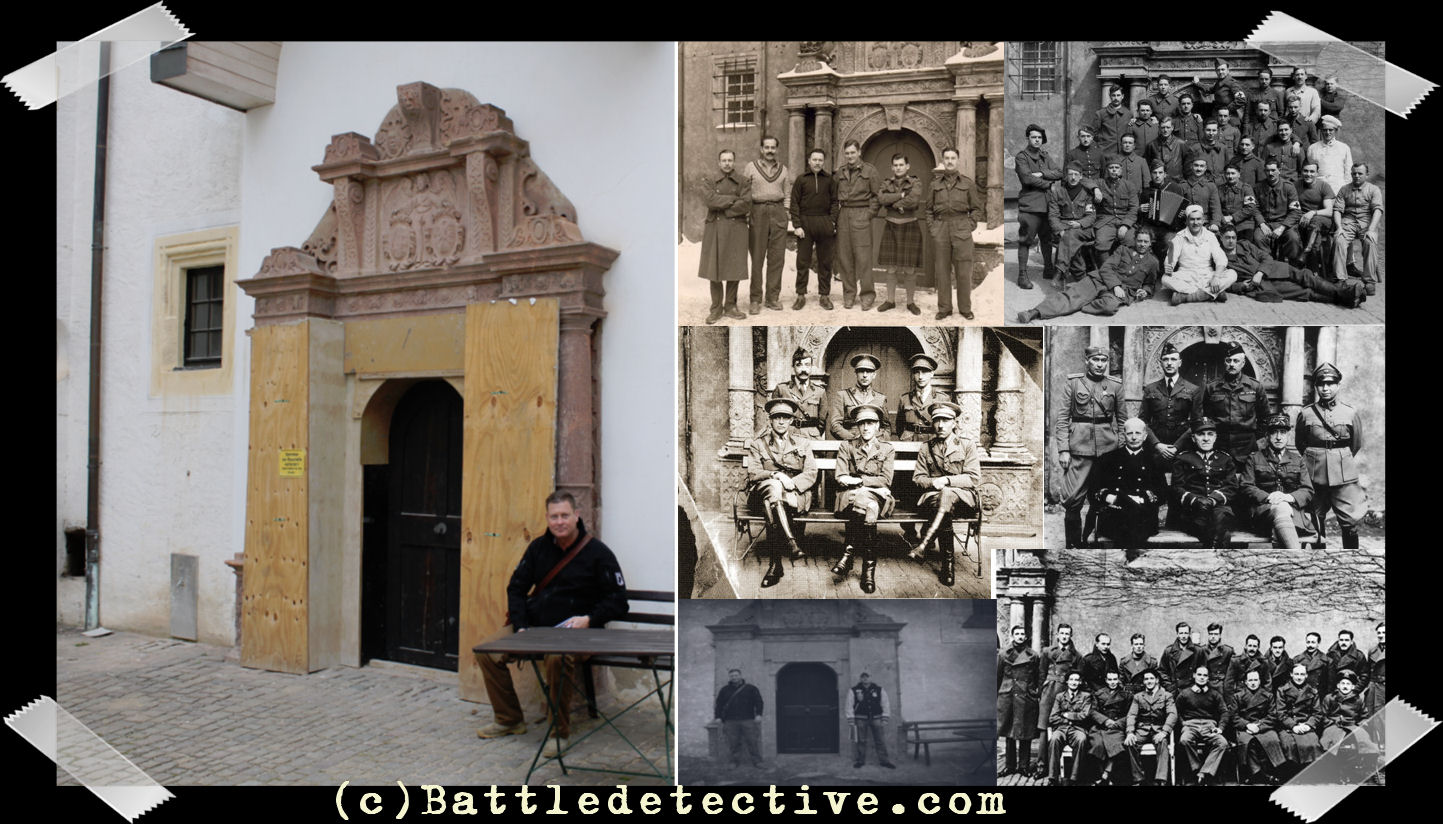 |
Colditz, Germany, 1939-1945
The ornate main entrance in the
court yard served as the back ground
for many group photos of Allied
officers imprisoned at Colditz
Castle. "Then-"section, top to
bottom, left to right: "The Laufen
Six" some of the first British
officers who entered Oflag IV-C on
November 7th 1940, French officers,
Belgian officers, Polish officers,
Battle detectives Tom & Wilbert,
British officers.
|
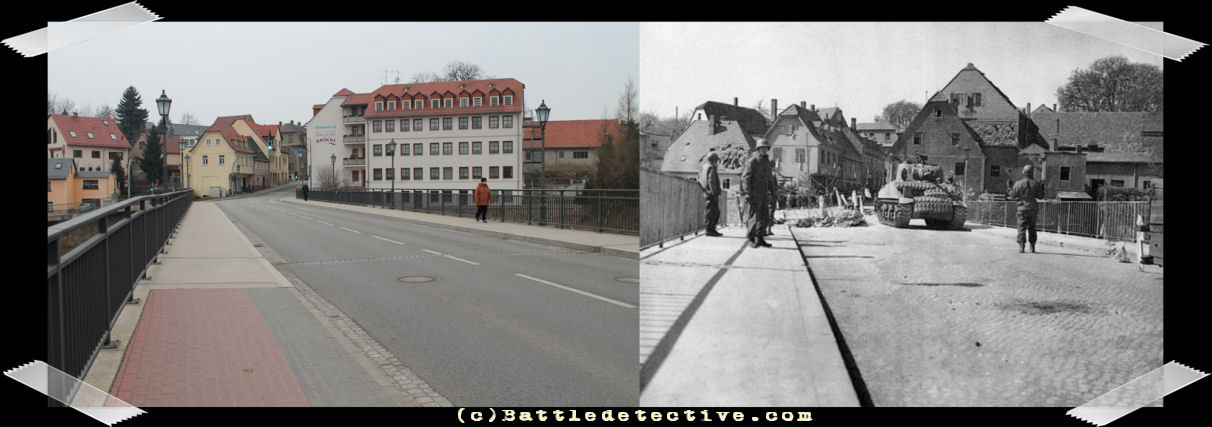 |
Colditz, Germany, April 16th 1945
American GI's and an M4 Sherman
tank on the river Mulde bridge in
the town of Colditz. Until this
moment the bridge was known as
"Adolf Hitler Brücke".
|
.jpg) |
Berlin, Germany, May 2nd 1945
Soviet Army Army photographer
Yevgeny Khaldei 'shot' Private
Alexei Kovalyov from Kiev while
rasing the Red Flag on the German
Reichstag. It took this agency some
effort to find the correct location
of
Khaldei's position. |
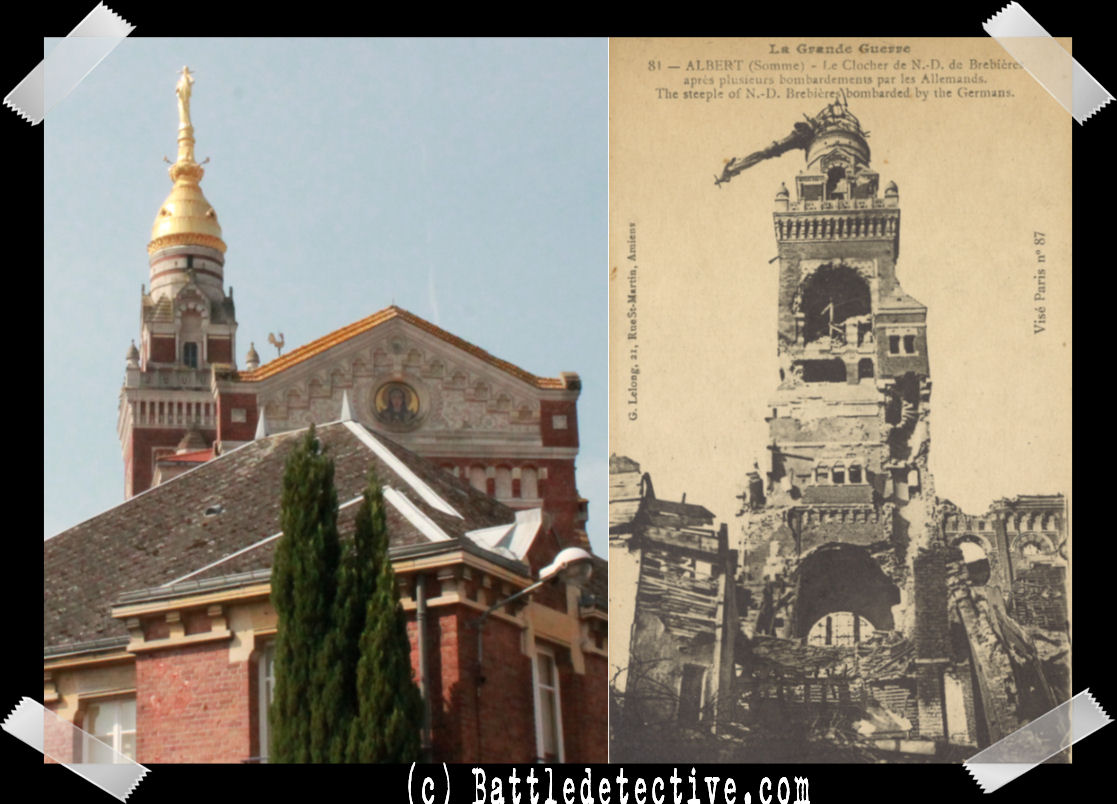 |
Albert, France, January 15th 1915
During World War I, the statue
of Mary and the infant Jesus on the
Albert basilica was hit by a shell
on January 15, 1915, and slumped to
a near-horizontal position, where it
remained until further shelling in
1918 destroyed the tower.
The British said that whoever made
the statue fall would lose the war,
whilst the Germans thought the
opposite.
The "Leaning Virgin" became a
familiar image to the British
soldiers who fought at the Battle of
the Somme in 1916. |
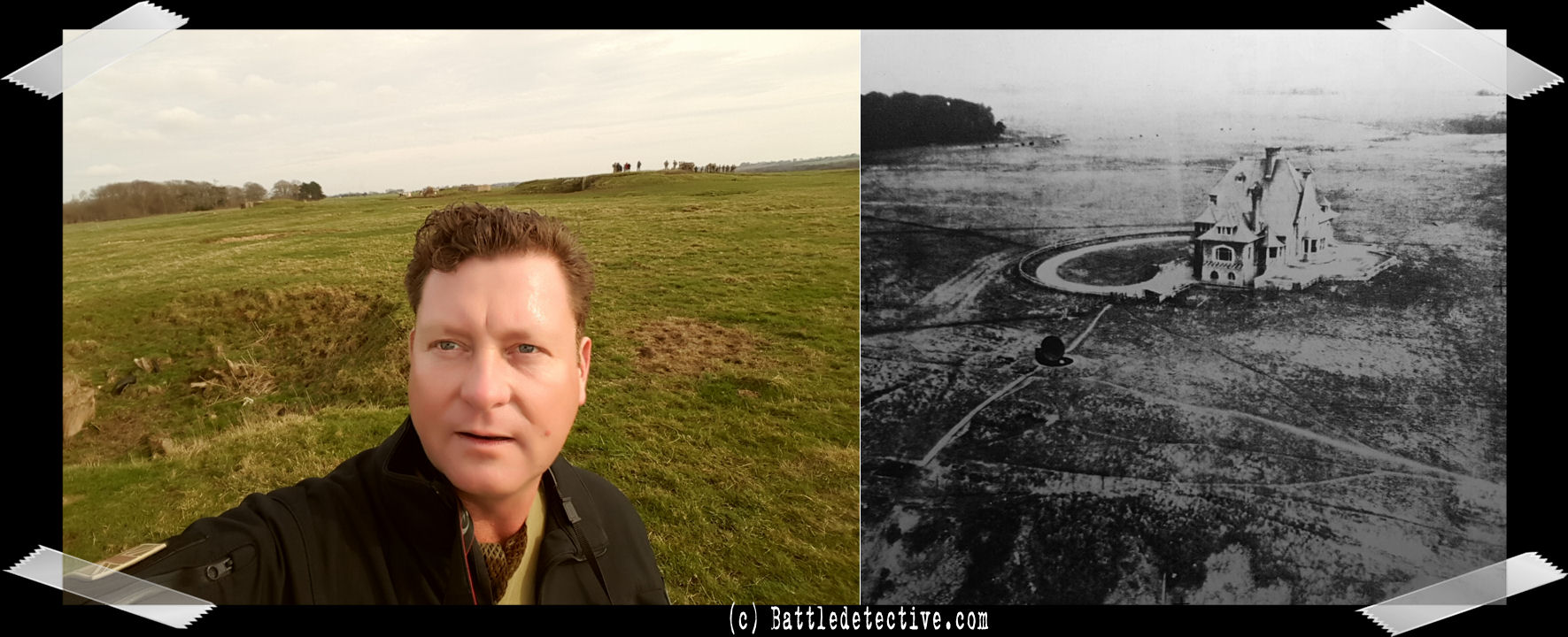 |
Bruneval, France, February 1942
R.A.F. photo of the German
"Wurzburg" radar station near
Bruneval on the French coast. On
February 27th 1942 120 British
paratroopers conducted a raid on the
radar station. 75 years later, this
agency was on the spot where the
"Wurzburg" used to be. Note remains
of the villa in the background. |
 |
Dieppe, France, August 19th 1942
Canadian soldiers, taken
prisoner after the August 19th 1942
raid on the French coastal town of
Dieppe, are marched inland along the
Rue de Sygogne, the only street with
an access gate from the sea front
promenade into town. |
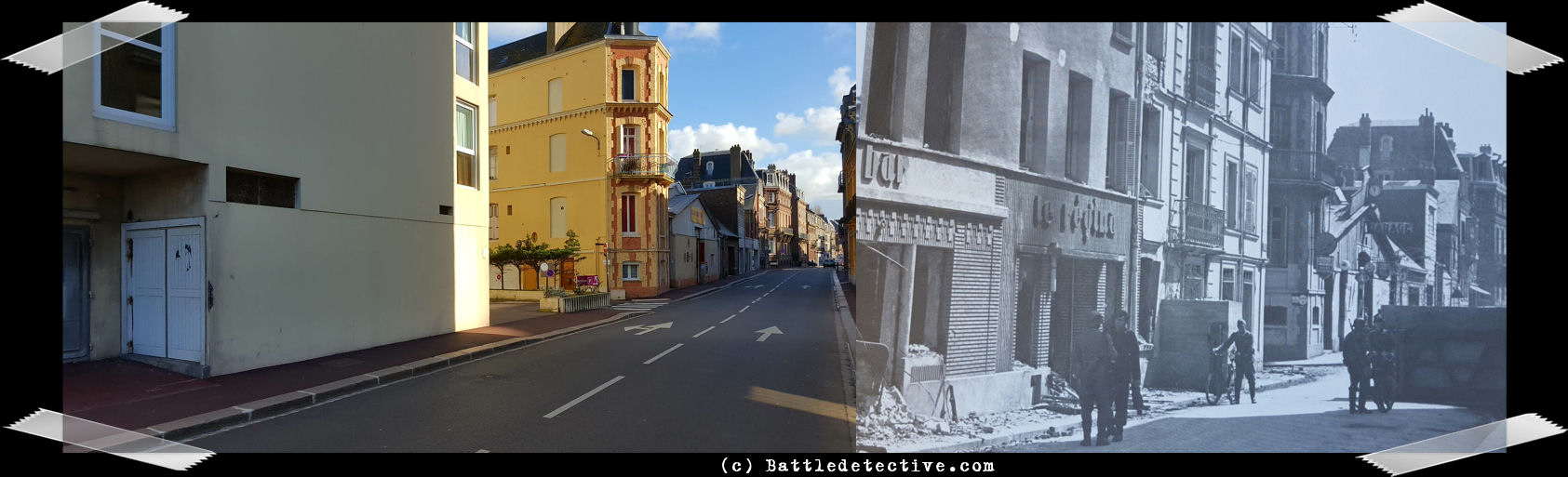 |
Dieppe, France, August 19th 1942
A few hundred yards up the same
Rue de Sygogne towards the sea
front, with a concrete roadblock
constructed by the Germans. The
buildings on the left are replaced
by modern ones today. |
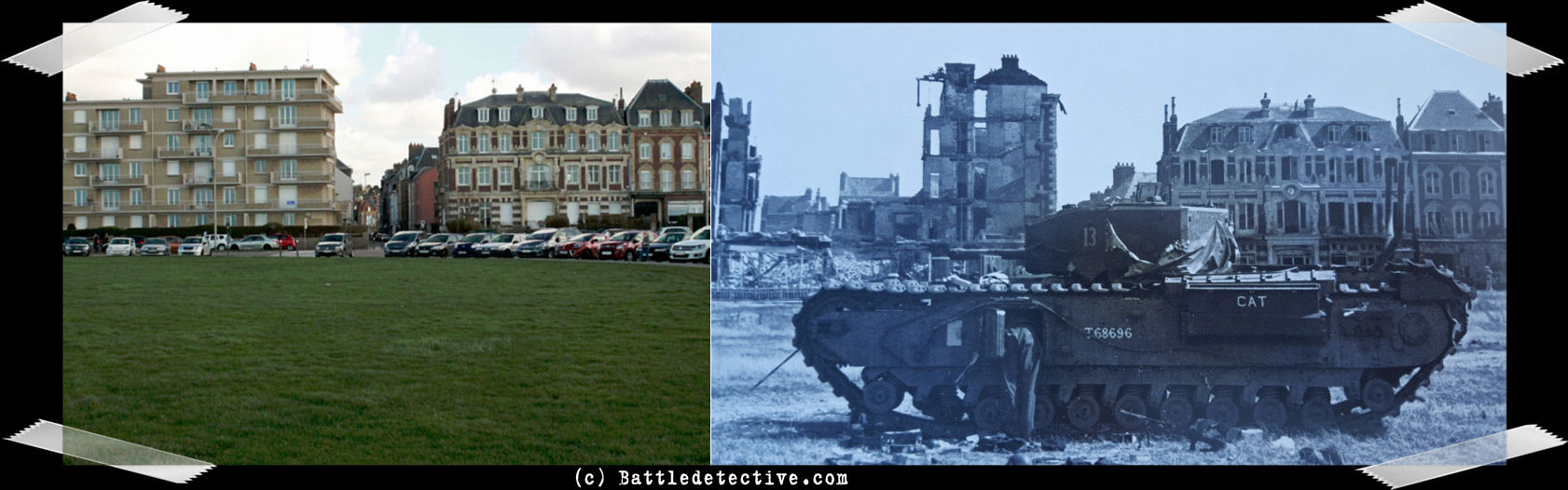 |
Dieppe, France, August 19th 1942
"Cat" was one of the Canadian
Churchill tanks that made it across
the beach onto the esplanade. It
cruised up and down for hours firing
its guns into the houses in the
background until a Ju87 "Stuka" dive
bomber knocked it out. |
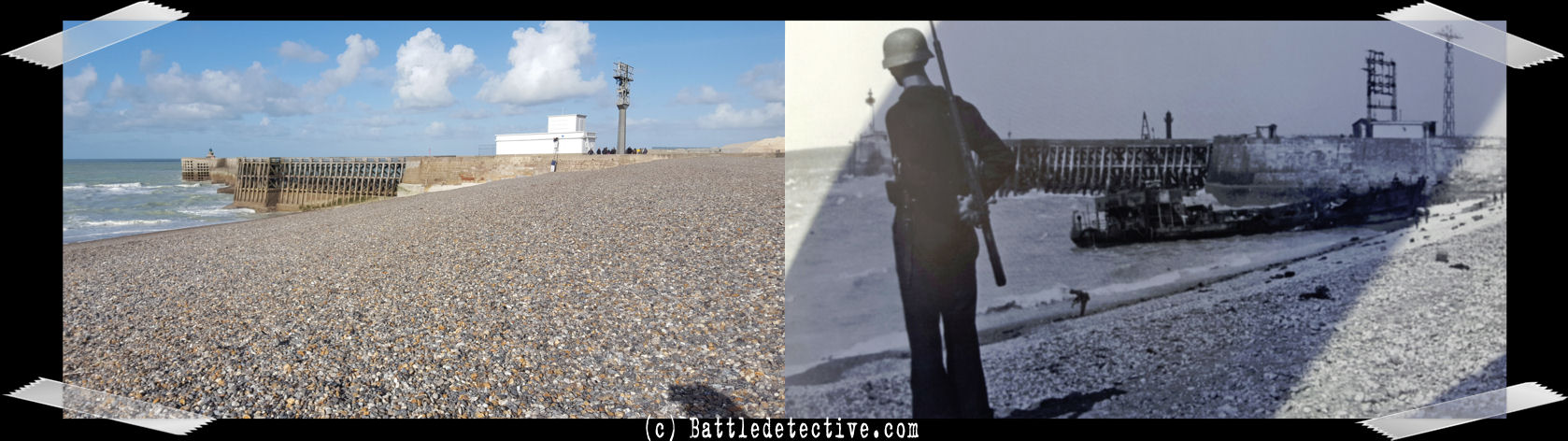 |
Dieppe, France, August 19th 1942
TLC (Tank Landing Craft)1, which
succeeded in bringing in 3 Canadian
tanks and a scout car on the eastern
end of "Red" beach, was hit several
times by enemy coastal artillery and
sank in shallow waters near the West
Jetty. |
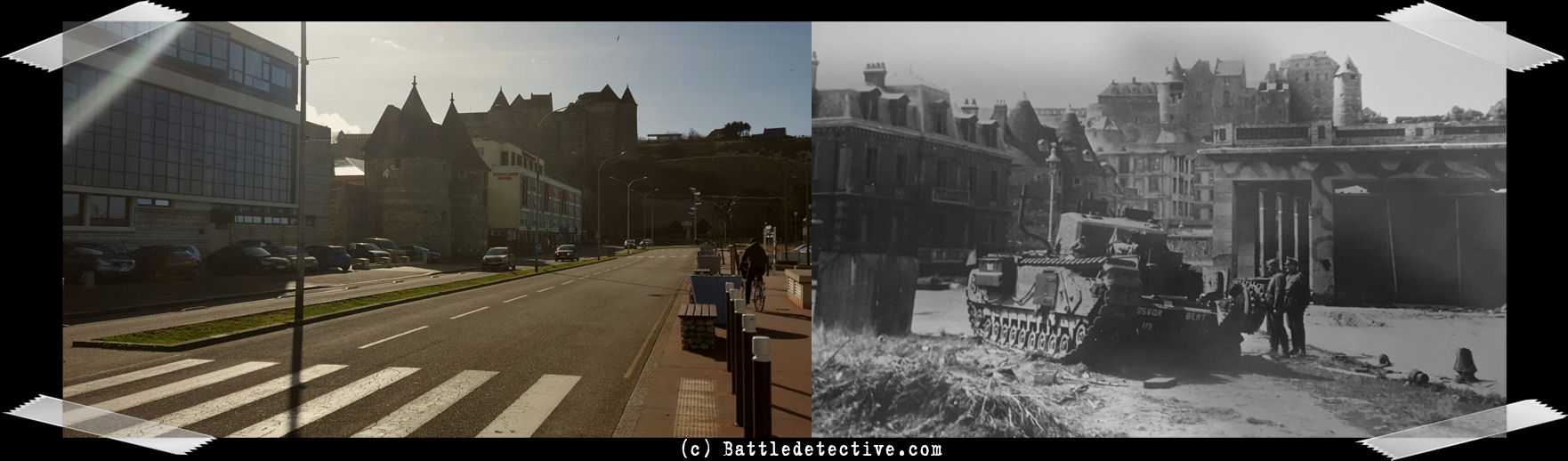 |
Dieppe, France, August 19th 1942
Canadian Churchill tank "Bert"
made it across the beach but was put
out of action when its left track
was blown off near the casino of
Dieppe; the camouflaged building on
the right. Note the medieval chateau
in the background. |
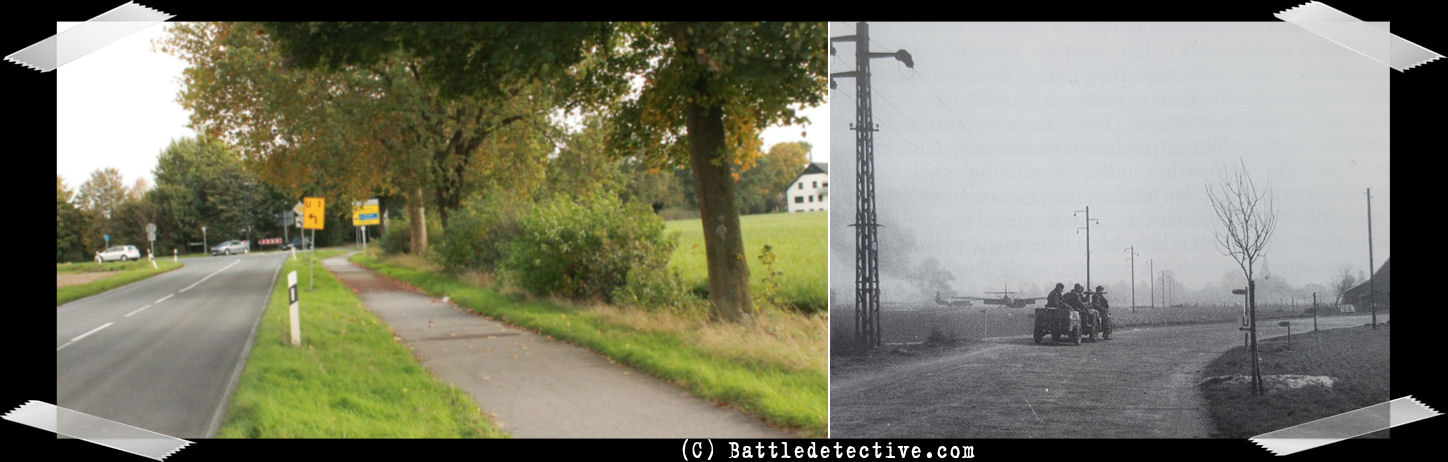 |
Hamminkeln, Germany, March 24th
1945
Drop- and Landing zones of the
6th Airborne Division north-west of
Hamminkeln. A jeep and trailer on
Mehrhooger Strasse at the point
where West Strasse branches off as
"Umgehungsstrasse" or ring road;
hence the letter "U" on the signs
Now and Then. |
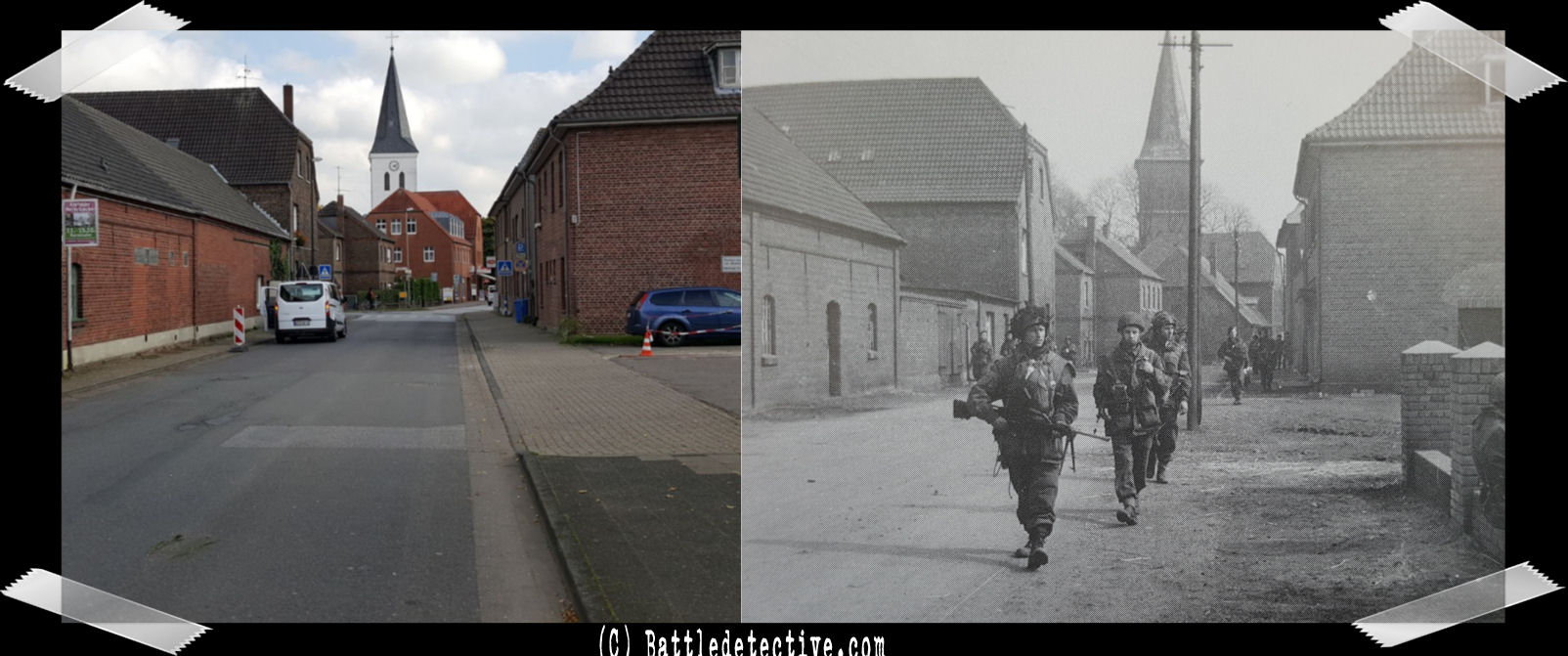 |
Hamminkeln, Germany, March 24th
1945
British Airborne infantrymen of
"D" Company, The Devonshire Regiment
regroup at the elementary school on
Mehrhooger Strasse in Hamminkeln. |
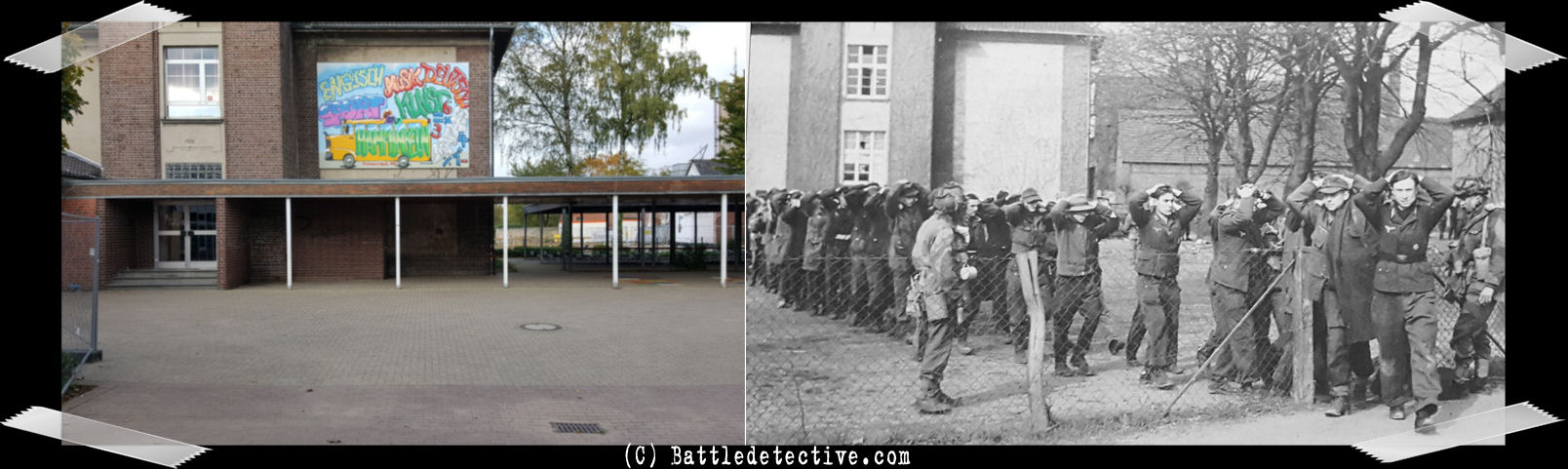 |
Hamminkeln, Germany, March 24th
1945
The elementary school's
playground, located at the back of
the elementary school along
Bislicher Strasse, was used as a
collecting point for German
prisoners of war. |
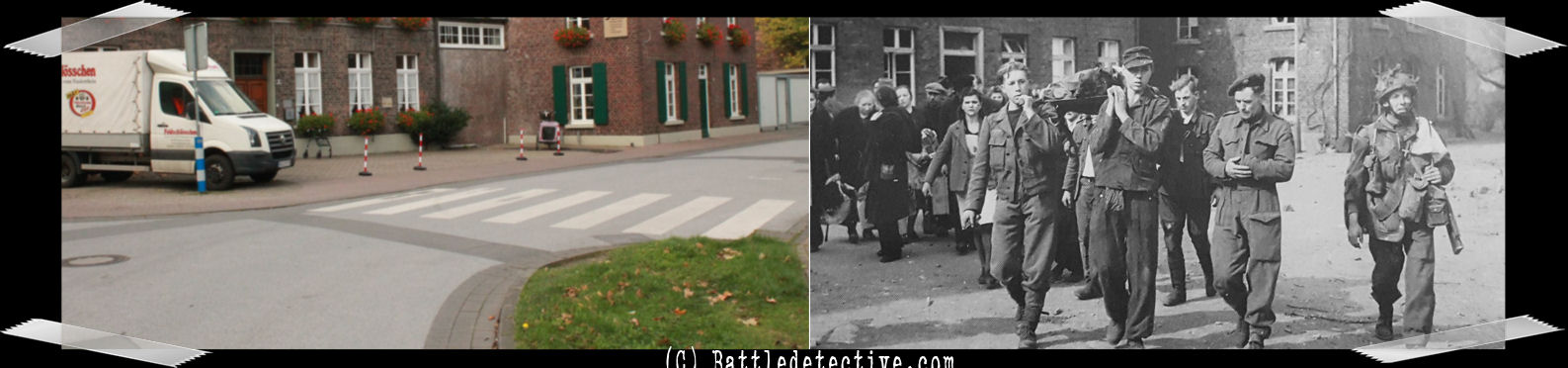 |
Hamminkeln, Germany, March 24th
1945
A group of German civilians and
prisoners of war is led away from
the Kloppert brewery. The civilians
were sent to the Evangelist church. |
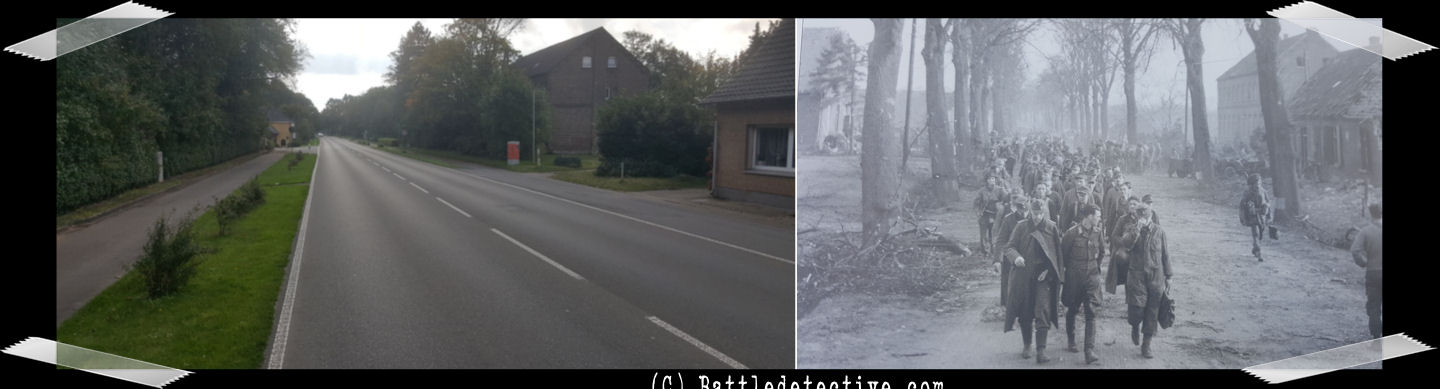 |
Bergerfurth, Germany, March 24th
1945
German POW's are brought in on the
first day of Operation “Varsity”. On
the right is the Bergerfurth
elementary school. The church on the
left is no longer there. |
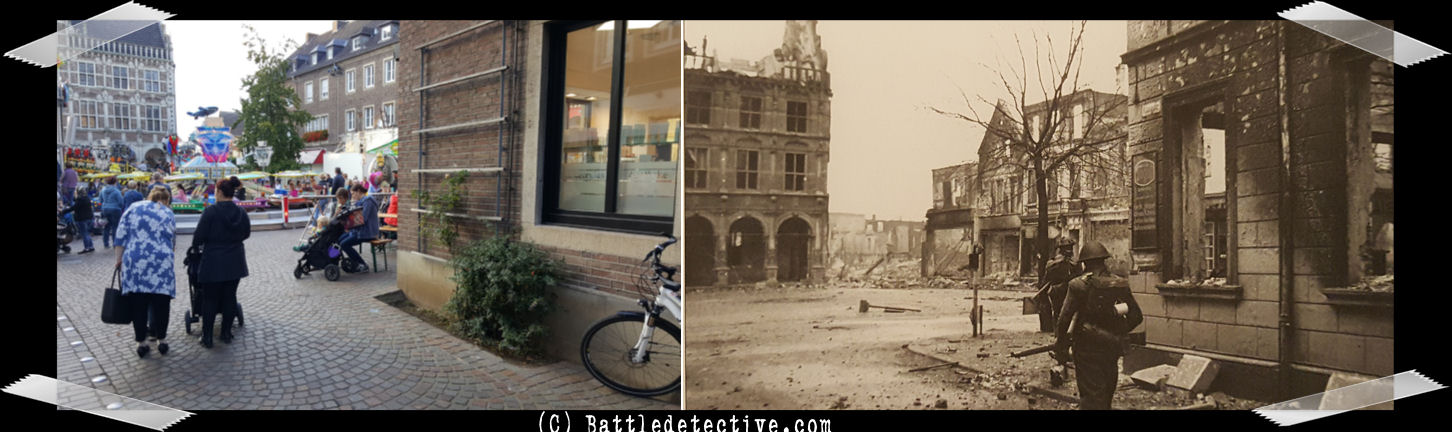 |
Bocholt, Germany, March 29th 1945
British infantrymen in front of the
historical city hall of Bocholt. |
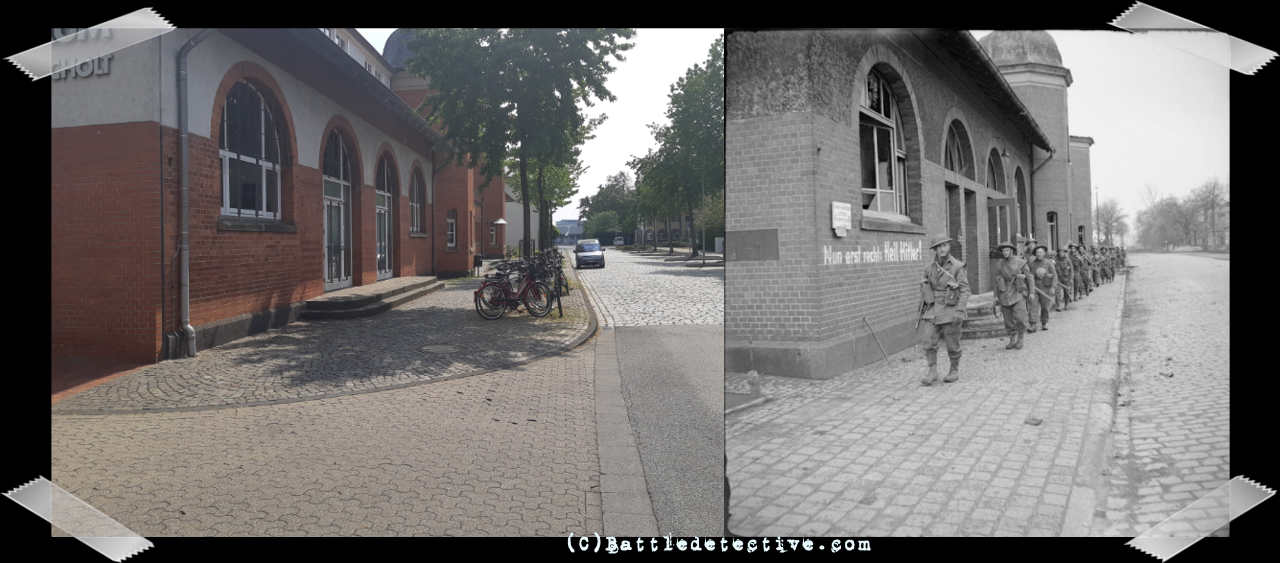 |
Bocholt, Germany, March 29th 1945
Infantry of the 2nd Battalion of the
Monmouthshire Regiment, 53rd (Welsh)
Division move forward at the railway
station on March 29th 1945. On the
wall is a Nazi graffiti saying: "Now
more than ever: Heil Hitler!" |
.jpg) |
Camp Mourmelon, France, December
1944
After having been in combat for 72
in Holland since the beginning of
Operation Market Garden, the 101st
Airborne Division was finally given
a well deserved rest. The troops of
the division were billeted in brick
barracks in the French army camp
near Mourmelon-le-Grand. This is the
guard house building which served as
division CP while Division HQ was
quartered in the school building in
Reims where on May 7th 1945 German
General Jodl signed the surrender
instrument on behalf of all Third
Reich armed forces in Europe.
|
.jpg) |
Camp Mourmelon, France, December
1944
The CP building has not changed
much and is located next to the D21
highway outside the town of
Mourmelon-le-Grand proper.
|
.jpg) |
Camp Mourmelon, France, December
1944
According to historian Mark
Bando's "Vanguard of the Crusade"
Sergeant
Ed Hallo of "A" Company, 501st
Parachute Infantry Regiment was
detailed to lower the American flag
on the roof of the CP every evening. |
.jpg) |
Camp Mourmelon, France, December
18th 1944
Troops of the 101st Airborne
Division preparing to deploy to the
Belgian Ardennes. Note jeep with "geen
liefde" painted on the windshield.
Something the trooper in the
passenger seat might have picked up
in Holland meaning "no love" in
Dutch. |
.jpg) |
Reims, France, May 7th 1945
Celebrating the German surrender
and the end of World War 2 in the
ETO, Paratroopers of the 101st
Airborne Division parade in Reims on
Place Myron Herrick into Rue Carnot.
The view is down Rue du Trésor with
the Notre-Dame cathedral in the
background. |
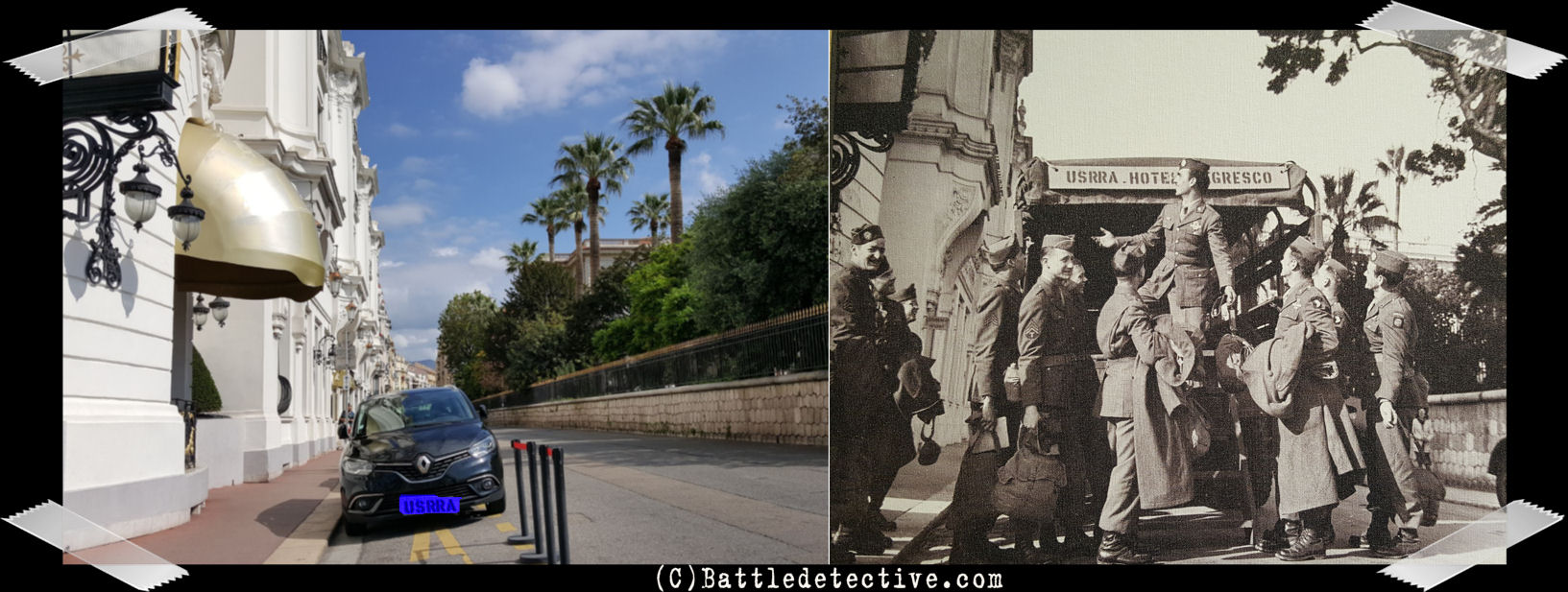 |
Nice, France, Summer 1945
The famous Negresco hotel in
Nice, Southern France. In the
"Then-"photo American paratroopers
of the 82nd and 101st Airborne
Division arrive at the hotel on
Promenade des Anglais for some well
deserved Rest & Relaxation. |
 |
Raversijde, Belgium, December
1943
Tall Battle Detective Ivo stands
in for the German sentry in the
"Then-"photo in which Field Marshall
Erwin Rommel is shown inspecting the
Raversijde Battery, part of the
Atlantik Wall, in December 1943. The
letters UvD on the concrete sentry
box stand for "Unteroffizier vom
Dienst", or Duty Non-Commissioned
Officer. The battery is now part of
the
Raversyde Atlantik Wall Museum;
which is well worth a visit. |
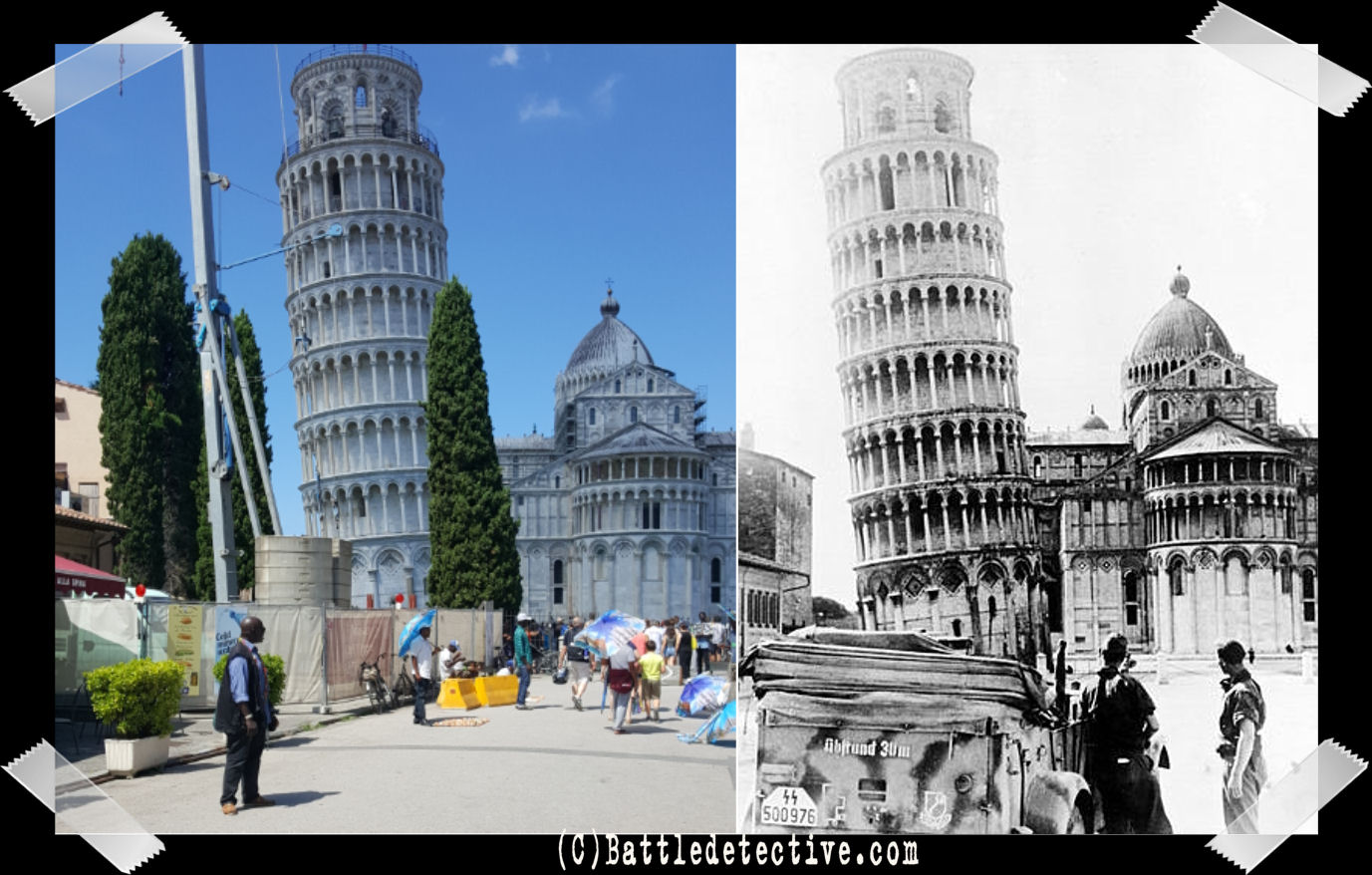 |
Pisa, Italy, 1943
SS soldiers admire the Cathedral
in Pisa with the famed Leaning Tower
in the foreground, in 1943, during
the German occupation of Italy in
World War Two. |
 |
Pisa, Italy, September 6th 1944
US Army Signal Corps photo
MM-5-44-10249: American soldiers
enter the Piazza dei Miracoli in
Pisa with the cathedral and famous
Leaning Tower while liberating the
city on September 2nd 1944. |
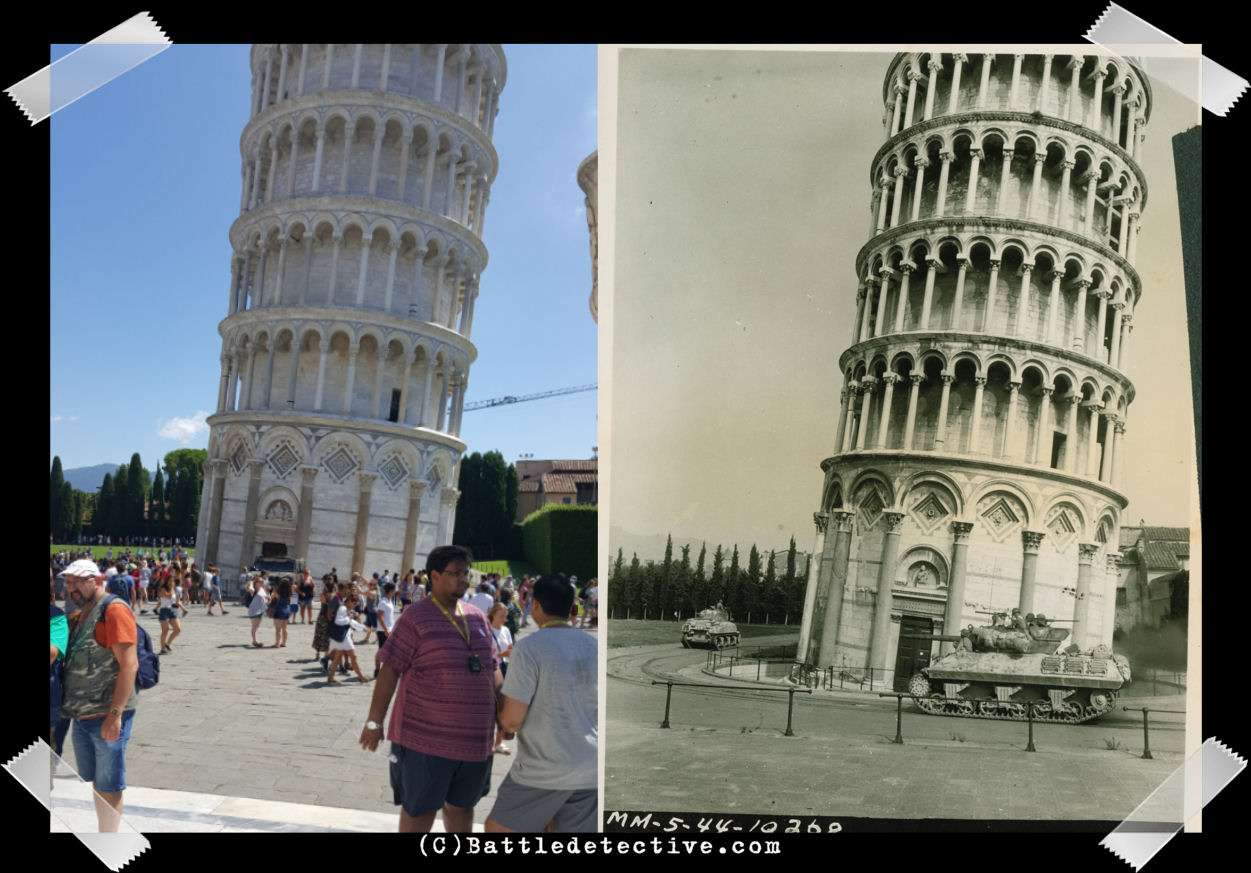 |
Pisa, Italy, September 6th 1944
US Army Signal Corps photo
MM-5-44-10268 with official caption:
"American tanks on way to front,
circle past the famed 'Leaning
Tower.' Pisa, Italy. 6 September
1944". Today an Italian Army vehicle
stood in for the American M10 tank
destroyer in front of the tower. The
tank on the left of the "Then-"photo
is an M4 Sherman tank. |
.jpg) |
Leipzig, Germany, April 18th 1945
A lone rifleman of the American
69th Infantry Division enters the
crypt in the "Volkerschlachtdenkmal";
the gigantic monument to commemorate
the Battle of the Nations in 1813.
The building was heavily defended by
SS troops. |
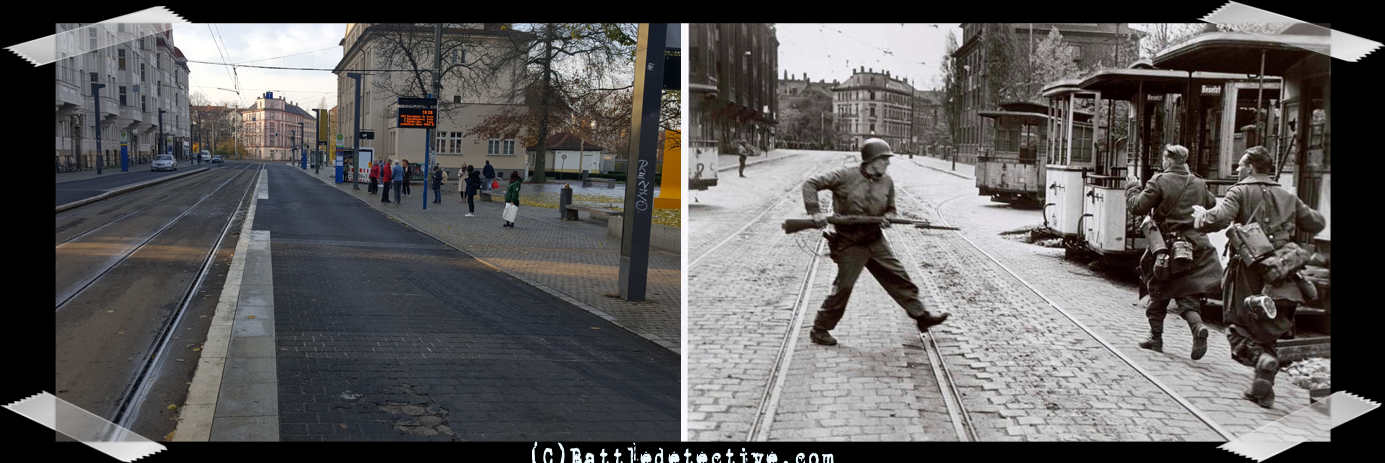 |
Leipzig, Germany, April 18th 1945
The following 7 comparisons are from
a series of photos taken by war
photographer Robert Capa shortly
after an American machine-gunner on
a nearby apartment building balcony
was killed by a German sniper. |
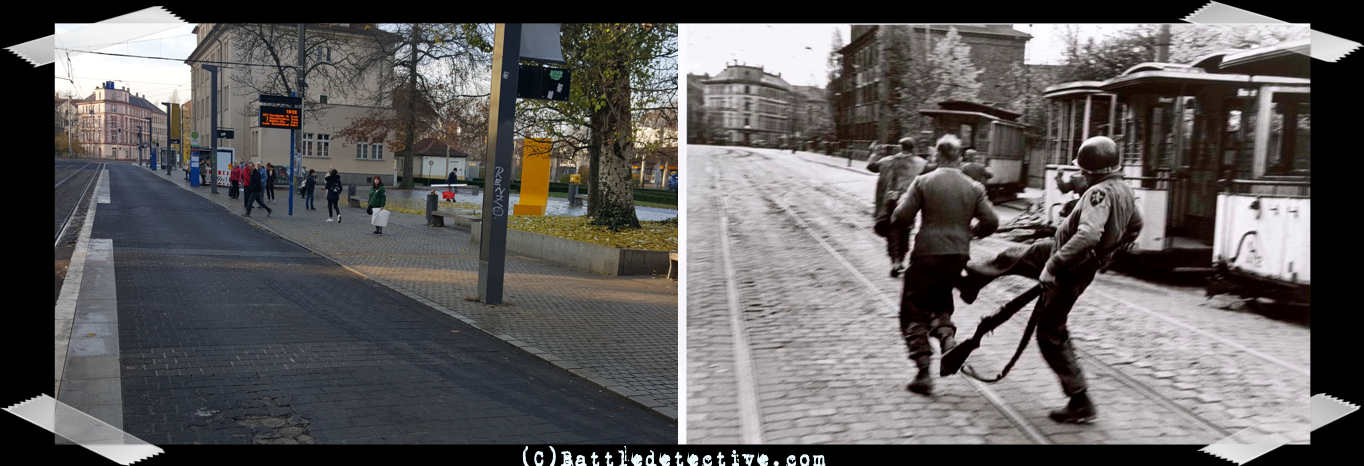 |
Leipzig, Germany, April 18th 1945
Street cars have been placed on
the street and weighed down with
bricks to create a road block
against the American attackers. A
buddy of the machine-gunner who got
killed nearby charges at German
Prisoners of War with fixed bayonet. |
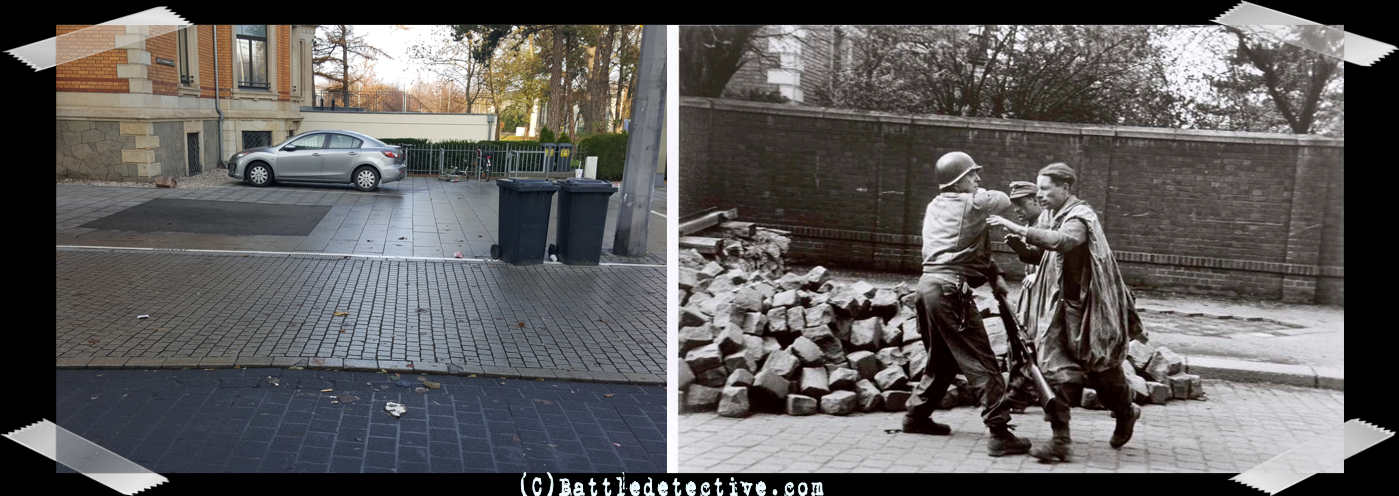 |
Leipzig, Germany, April 18th 1945
More German soldiers surrender
and run passed the angry GI. The
wall in the background is gone but
the building behind it, still stands
and is home to the Leipzig
grassroots and youth sports Club ("Sportgemeinschaft
Leipziger Verkehrsbetriebe"). |
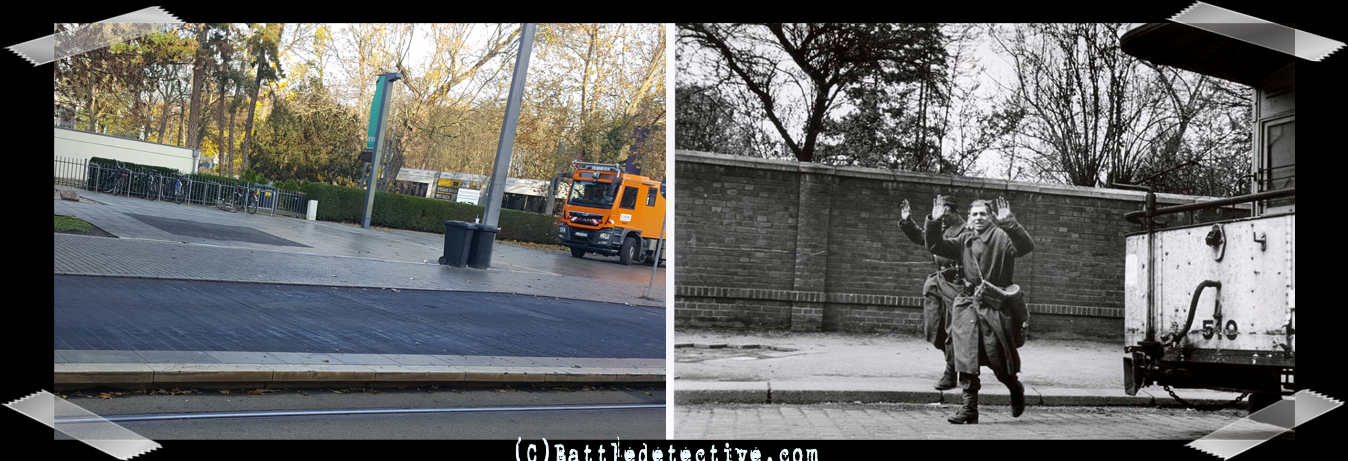 |
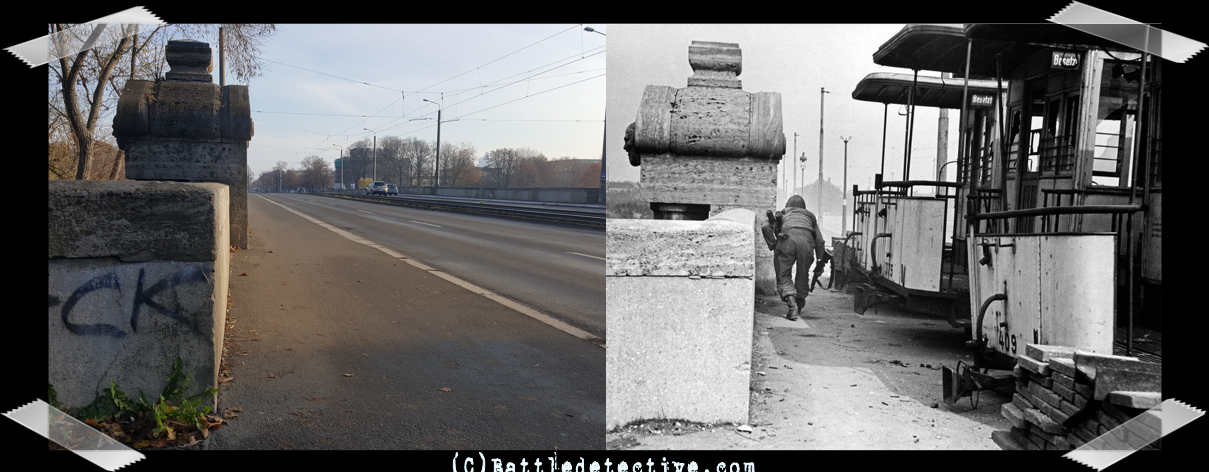
Leipzig, Germany, April 18th 1945
With their hands up, even more
German soldiers surrender. The
"Now-" location could only be
identified by comparing the pavement
with the missing bricks in the
previous photo in Robert Capa's
series. |
 |
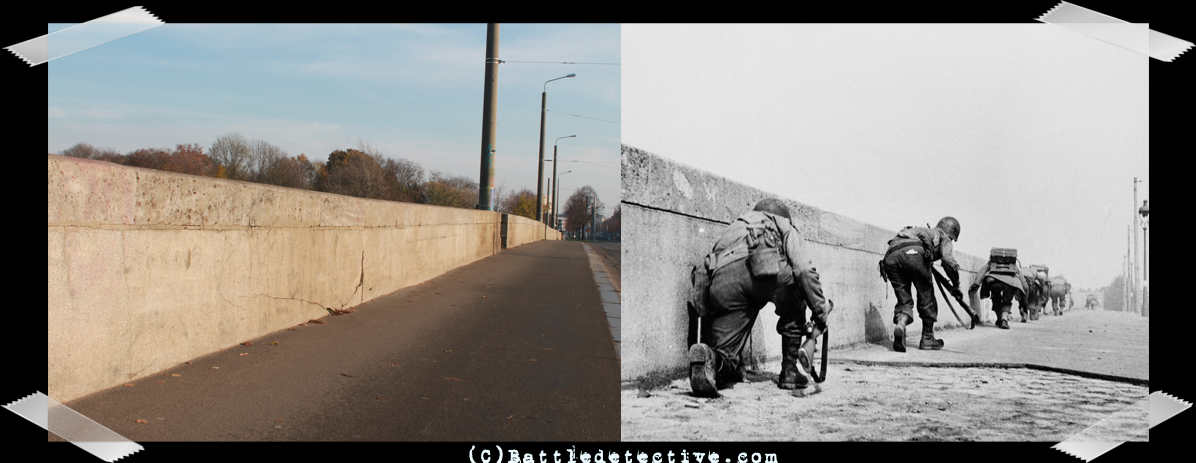
Leipzig, Germany, April 18th 1945
Capa then followed American
soldiers of the 2nd ("Indian Head")
Infantry Division move east towards
the center of the city while German
soldiers are running in the opposite
direction with their hands up in
surrender.
|
 |
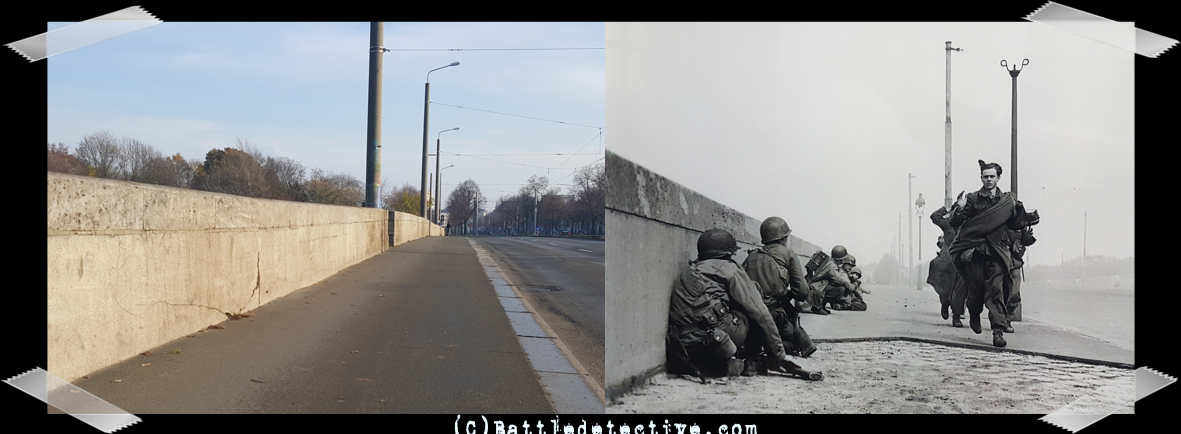
Leipzig, Germany, April 18th 1945
The bridge carries traffic on
Jahnallee across the Elsterbecken
river. In July 1945 the Americans
withdrew from Leipzig, retiring
westward to the line that marked the
designated postwar zones of
occupation and the Red Army moved
in. |
 |
Leipzig, Germany, April 18th 1945
The Americans are still cautious
as these images were taken only
moments after the killing of their
buddy Raymond Bowman; perhaps by the
very Germans speeding passed them
here.
|
|
Back to Now&Then Page |







.jpg)
.jpg)
.jpg)
.jpg)
.jpg)
.jpg)